Developed an Agent Skill for estimating ambiguous requirements
Requirement Blueprint is an Agent Skill that helps AI analyze ambiguous customer requirements before estimation. It structures scope, features, flows, tasks, open questions, and risks while separating confirmed facts from assumptions. Benchmarks showed a 26.9% higher average score than baseline.
On this page
At the beginning of a project, customer requirements often consist of only a few short sentences.
For example:
I want to build a mobile app where users can find nearby badminton courts and book available time slots. Court owners should also be able to manage their courts and bookings.
The problem is that there are still many gaps between this initial requirement and a plan that is clear enough for the team to estimate.
What exactly does “manage bookings” mean? Does it include viewing, confirming, cancelling, or rescheduling bookings?
Will the app support payments?
Does it need an approval flow?
If AI makes assumptions about these details and immediately breaks the project down into tasks, the resulting estimate can easily be based on requirements the customer has never confirmed.
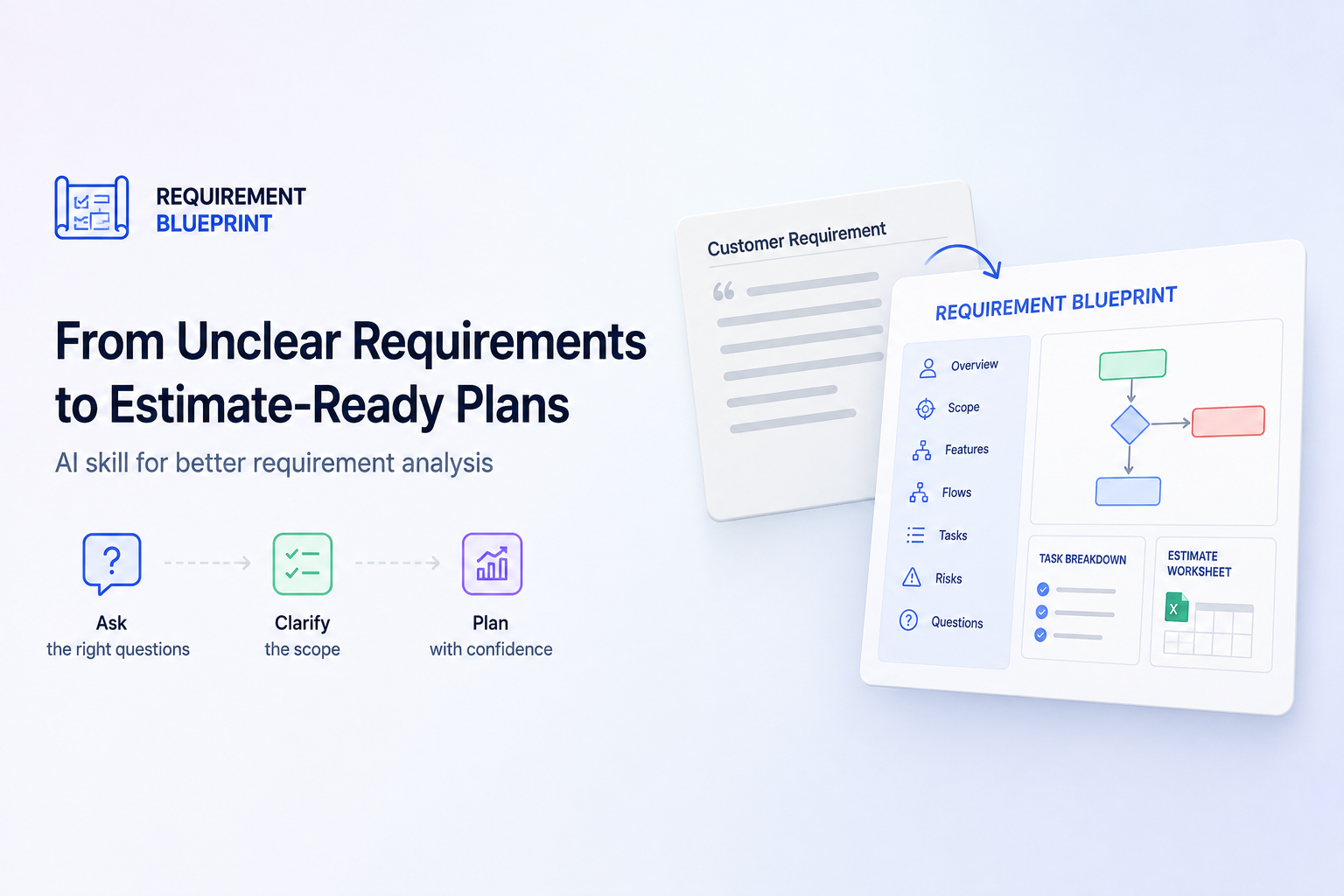
To address this problem, I built Requirement Blueprint, a set of Agent Skills that helps AI act as a BA or pre-sales analyst before development begins.
The complete source code, installation guide, input examples, and benchmark results are publicly available in the repository below. You can install the skill in your preferred AI agent or run it directly with a customer brief to see how it analyzes requirements.
View the source code and usage guide:
Requirement Blueprint on GitHub
What Can Requirement Blueprint Do?
From a short customer brief, the skill can help AI produce:
- Project scope
- Feature list
- Actors
- Scenarios
- User flows and diagrams
- Project phases
- Task breakdown
- Dependencies
- Open questions
- Estimation risks
- Estimate worksheet
More importantly, the skill attempts to clearly distinguish between CONFIRMED, ASSUMED, NEED CLARIFICATION, and OUT OF SCOPE. For delivery readiness, it also labels items as either READY or BLOCKED.
For example, if a customer says:
Court owners can manage bookings.
the skill does not immediately interpret this as:
approve
reject
cancel
reschedule
refund
Instead, it can keep the feature in the following state:
CONFIRMED + BLOCKED
until the customer clarifies which actions “manage” actually includes.
In addition to the main skill, the repository also provides:
/generate-slide
/generate-estimate
These skills turn a requirement plan into PDF/PPTX slides and an Excel worksheet that the team can use for estimation.
Results in Practice
To determine whether Requirement Blueprint genuinely helps AI analyze requirements more effectively, I created a benchmark containing 10 different project requests. These requests were intentionally kept short or left partially ambiguous to reflect the kinds of requirements teams often receive during the early stages of a project.
The benchmark includes use cases such as badminton court booking, e-commerce, medical appointment booking, and task management. It also includes several special cases designed to test whether AI adds unconfirmed requirements when the available information is insufficient.
Each requirement was tested under four conditions:
| Agent | Without Skill | With Skill |
|---|---|---|
| Cursor | ✓ | ✓ |
| Codex | ✓ | ✓ |
This means that every requirement was run four times. With 10 requirements, the benchmark contained a total of:
10 requirements
× 2 agents
× 2 conditions
= 40 runs
Running both the skill and baseline conditions on the same requirement makes it possible to directly compare the difference Requirement Blueprint produces, rather than evaluating the skill’s output in isolation.
How Were the Results Scored?
Each output was evaluated against 10 criteria, with each criterion scored from 0 to 5. The maximum score for a single run was therefore 50 points.
| Criterion | What It Evaluates |
|---|---|
| Requirement Understanding | Whether the AI correctly understands the request and distinguishes confirmed information from assumptions |
| Scope Clarity | Whether the scope is clear and avoids introducing unrequested functionality |
| Clarification Quality | Whether the clarification questions genuinely affect scope, cost, or user flows |
| Feature Coverage | Whether the main feature groups are identified without adding too many features beyond the request |
| Scenario Coverage | Whether the output describes the main flow, alternative flows, and important failure cases |
| Diagram Quality | Whether the diagrams match the scenarios and are useful in discussions with the customer or team |
| Project Phase Breakdown | Whether the phases are logical, properly ordered, and reflect dependencies |
| Task Breakdown | Whether tasks are detailed enough to estimate, grouped logically, and traceable to features |
| Estimate Readiness | Whether the output contains enough information for the team to begin a rough estimate |
| Hallucination Control | Whether the AI avoids presenting assumptions or inferred information as confirmed requirements |
The complete scoring method is defined in the benchmark’s Evaluation Rubric.
The same rubric was used to score both Cursor and Codex. The goal was to evaluate the output as a BA/pre-sales document rather than judge its writing style.
Benchmark Results
After all 40 runs were scored, the average results were:
| Without Skill | With Skill | |
|---|---|---|
| Average score | 36.6 / 50 | 46.45 / 50 |
Using Requirement Blueprint increased the average score by 9.85 points on a 50-point scale, an improvement of approximately 26.9% over the baseline.
The benchmark also allowed each result to be compared directly with its counterpart. With 10 requirements × 2 agents, there were 20 comparison pairs in total. Each pair consisted of the same requirement run on the same agent, once without the skill and once with it.
In all 20 out of 20 comparisons, the output produced with Requirement Blueprint scored higher than the output produced without it.
Broken down by agent, the results were:
| Agent | Without Skill | With Skill | Improvement |
|---|---|---|---|
| Cursor | 34.4 / 50 | 43.6 / 50 | +26.7% |
| Codex | 38.8 / 50 | 49.3 / 50 | +27.1% |
The most noticeable improvements were in Task Breakdown, Estimate Readiness, Scope Clarity, and Hallucination Control.
This aligns closely with the repository’s original goal. Requirement Blueprint was not created to make AI more intelligent. It was created to introduce a clear process for analyzing requirements before the team begins estimation.
The complete benchmark methodology, raw outputs, and detailed results are available in Requirement Blueprint Benchmark v0.3.
How to Use It
There are two ways to use this skill with your agent.
Option 1: Install Requirement Blueprint as an Agent Skill
This is the recommended option if you plan to use it regularly.
Clone the repository:
git clone https://github.com/khanhvo1104/Requirement-Blueprint-Skill.git
cd Requirement-Blueprint-Skill
For example, with Cursor:
mkdir -p .cursor/skills

ln -sf "$(pwd)/skills/requirement-blueprint" .cursor/skills/requirement-blueprint
ln -sf "$(pwd)/skills/generate-slide" .cursor/skills/generate-slide
ln -sf "$(pwd)/skills/generate-estimate" .cursor/skills/generate-estimate
You can then call the skill directly in Cursor:
/requirement-blueprint
and enter your requirement:
I want to build a mobile app where users can find badminton courts near them and book an available time slot.

Court owners should also be able to manage their courts and bookings.
Once the requirement is sufficiently clear, you can continue with:
/generate-slide
to generate a PDF/PPTX presentation, and:
/generate-estimate
to generate an Excel estimate worksheet.
For other agents such as Codex or Claude Code, simply copy the skill folders into the agent’s corresponding skills directory.
Option 2: Run SKILL.md Directly Without Installing the Skill
If you only want to try it quickly, you do not need to install it in your agent.
Clone the repository or download this file:
skills/requirement-blueprint/SKILL.md
Then give it to the agent with the following instruction:
Read and follow all instructions in this file:

skills/requirement-blueprint/SKILL.md

Then analyze the following requirement:

I want to build a mobile app where users can find badminton courts near them and book an available time slot.

Court owners should also be able to manage their courts and bookings.
If the agent can access the repository, you can use a simpler instruction:
Please use the Requirement Blueprint skill in:

skills/requirement-blueprint/

to analyze the following customer requirement:

...
This option is suitable when you:
- Want to test the skill quickly
- Do not want to configure your agent
- Only need to use it once
- Want to benchmark it across multiple agents
If you plan to use the skill regularly, installing it as an Agent Skill is more convenient because the agent can invoke the workflow directly whenever needed.
Complete Workflow
After setup, the workflow can be as simple as:
Customer Requirement
        ↓
/requirement-blueprint
        ↓
Clarification
        ↓
Requirement Plan
        ↓
Validator
        ↓
/generate-slide
        ↓
PDF / PPTX
        ↓
/generate-estimate
        ↓
Excel worksheet
The repository also includes a complete Badminton Court Booking example containing the initial requirement, clarification, task breakdown, slides, and estimate worksheet, so you can quickly review a real output.
View the complete example here.
Conclusion
Requirement Blueprint was created to solve a straightforward problem:
AI can understand a requirement, but it does not always know which parts the customer has confirmed and which parts it has inferred on its own.
By introducing a BA workflow before development begins, AI can produce project plans that are clearer, easier to discuss, and better suited to rough estimation.
In the current benchmark, using the skill on the same set of requirements produced an average score approximately 26.9% higher than the baseline across Cursor and Codex. This figure represents the improvement measured by the benchmark rubric, not a reduction in development time or cost.
To try it yourself, visit the repository:
https://github.com/vfa-khanhvl/Requirement-Blueprint-Skill
You can also review the complete benchmark results and measurements here:
https://github.com/vfa-khanhvl/Requirement-Blueprint-Skill/blob/main/benchmark/reports/BENCHMARK_V03.md
Struggling to turn ideas into reality? With a proven track record of over 1,000 clients, our agile and flexible team will accelerate your business growth.