Isaac Sim Is Not Just a Heavyweight Unity — 4 Decisive Reasons to Move Beyond ML-Agents
Isaac Sim and Unity ML-Agents both support reinforcement learning, but differ greatly in architecture and robotics focus. This article compares GPU parallelism, contact physics, domain randomization, sensor simulation, and ROS 2/URDF/USD integration, while showing where Unity still excels.

On this page
- Physics Quality and Scale: GPU Parallelism That Breaks Through the PCIe Bottleneck
- Contact Dynamics and Joint Stiffness: Visual Plausibility or Physical Law?
- Domain Randomization and Sensor Emulation Designed for Sim-to-Real
- Native Integration with the Existing Robotics Ecosystem: ROS 2 / URDF / USD
- A Fair Comparison: Unity’s Strengths and the Barriers of Isaac Sim
- Where Unity (ML-Agents) Is Better
- The Barriers of Isaac Sim
- Conclusion: What Is the Same, and What Is Different?
When building simulation environments for reinforcement learning in robotics and AI development, many engineers have probably thought at least once: “Wouldn’t familiar Unity and ML-Agents be enough if we just add a URDF importer?”
And when they first try NVIDIA Isaac Sim, encounter its demanding hardware requirements and distinctive UI, many may come away thinking: “Isn’t Isaac Sim basically just an extremely heavy version of Unity that happens to support URDF and mesh collision detection?”
But that view only scratches the surface of the enormous iceberg that is Isaac Sim. Why has NVIDIA invested so heavily in building its own simulator, and why are robotics research institutions and companies around the world moving from Unity toward Isaac Sim?
In this article, we examine the decisive technical and structural differences between a game engine environment (Unity / ML-Agents) and a robotics platform (Isaac Sim) across four areas.
Physics Quality and Scale: GPU Parallelism That Breaks Through the PCIe Bottleneck
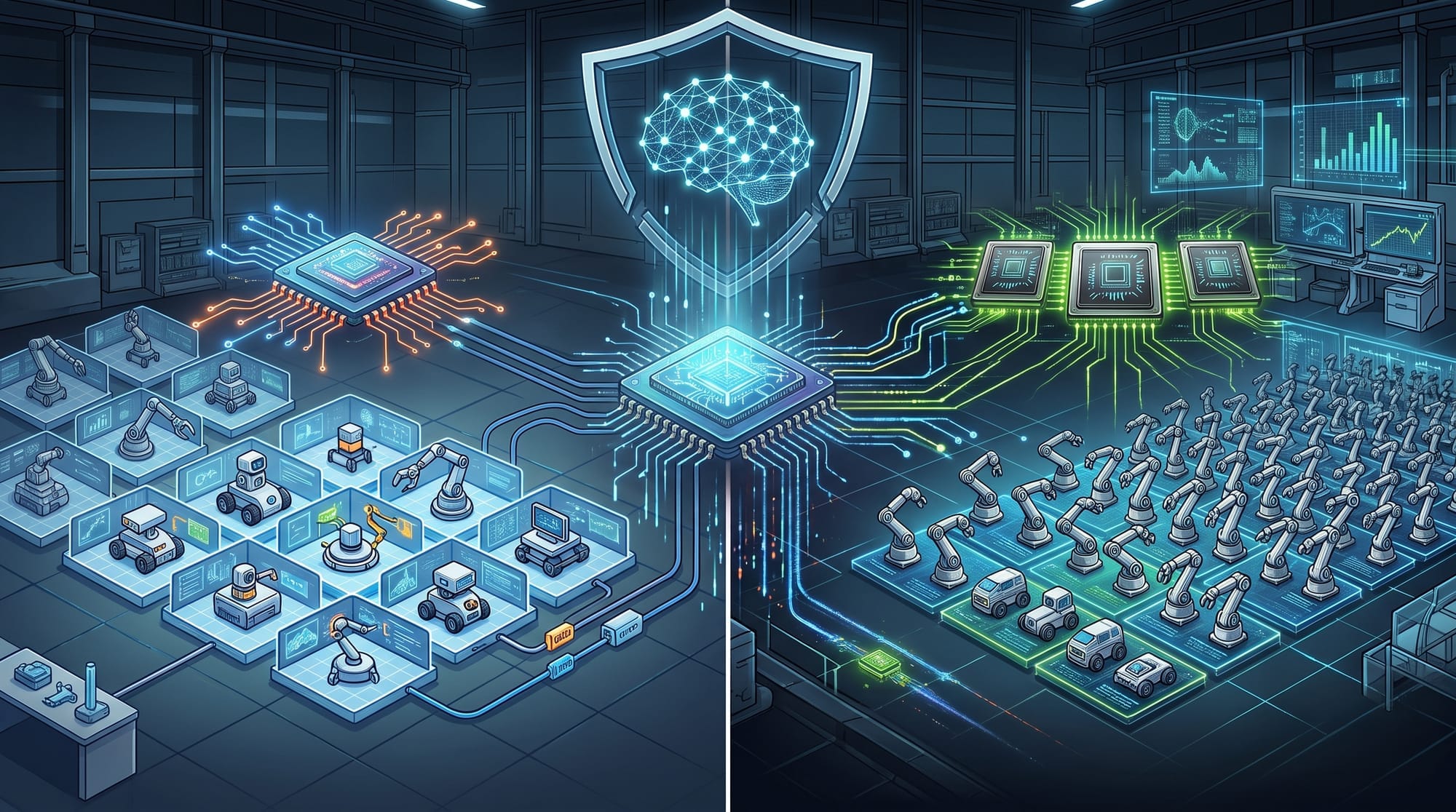
The biggest structural difference between Unity (ML-Agents) and Isaac Sim lies in the architecture itself: where the simulation is physically computed and how that computation is carried out.
The limitations of Unity ML-Agents
The CPU and process barrier
When reinforcement learning is performed in Unity, physics calculations (PhysX CPU) run on the CPU and in main memory.
The resulting state must then be passed to the Python side, such as PyTorch, and the inferred action must be returned through inter-process communication (IPC) using gRPC or sockets.
No matter how many CPU cores are added, the overhead of moving data from the CPU to main memory and then to the GPU for PyTorch becomes a serious bottleneck through PCIe bandwidth.
As a result, even with a high-spec PC, the number of parallel environments that can run simultaneously in Unity eventually hits a scale-out ceiling at around several thousand environments.
Isaac Sim keeps everything inside VRAM
Isaac Sim, together with Isaac Gym and its successor Isaac Lab, fundamentally removes this bottleneck.
Physics simulation (PhysX GPU), environment rendering, and tensor computation with PyTorch can all be completed inside GPU VRAM.
Because simulation physics data can be exchanged directly as PyTorch tensors in GPU memory without passing through the CPU, data-transfer latency is effectively eliminated.
This makes it possible to run tens of thousands to hundreds of thousands of robots in parallel on a single high-end GPU such as an RTX 4090 or A100.
Trial-and-error that would take months in the real world can be compressed into only tens of minutes of computation. This extraordinary time acceleration and scalability creates a fundamental difference in reinforcement learning.
Contact Dynamics and Joint Stiffness: Visual Plausibility or Physical Law?
At first glance, being able to perform collision detection with triangle meshes may seem like a small difference. But for Sim-to-Real—applying an AI trained in simulation to a real robot—it can make the difference between success and failure.
Unity from the perspective of a game engine
As a game engine, Unity’s highest priority is to maintain frame rates such as 60 fps and make motion look natural to the player.
For that reason, rebound forces when rigid bodies penetrate one another, joint stiffness, Coulomb friction, and similar behavior include many approximations and shortcuts intended to reduce computational load.
Spring-damper models designed to prevent visual instability are not the same as the torque actually produced by real robot motors.
Isaac Sim from the perspective of a robotics physics simulator
Isaac Sim, by contrast, performs calculations with numerical-analysis-level rigor based on formulations of multibody dynamics such as the Articulated Body Algorithm (ABA).
It can reproduce hardware characteristics of real machines, including motor torque limits, gear friction coefficients, stiffness, small amounts of joint backlash, and even sensor latency and noise. For example, when two sumo robots lock together, behaviors such as catching, slipping, and torque saturation similar to an overloaded motor can be modeled.
These effects cannot be reproduced by game-engine-level physics approximations, and once AI is deployed on a real robot they can lead to the classic Sim-to-Real tragedy: “It worked in simulation, but the robot falls over in reality.”
Isaac Sim uses the highly rigorous PhysX 5 physics solver to minimize this gap.
Domain Randomization and Sensor Emulation Designed for Sim-to-Real
The biggest reason Isaac Sim is described not merely as a simulator but as a robotics platform is that it integrates features intended from the start for deployment in the real world.
Advanced Domain Randomization
One of the strongest techniques for overcoming the difference between simulation and reality—the Sim-to-Real Gap—is Domain Randomization, which deliberately injects large amounts of variation and noise into the training environment.
In Isaac Sim, not only physical parameters such as robot mass, friction coefficients, and motor damping, but also visual parameters such as camera lens distortion, light reflections through ray tracing, textures, and lighting conditions can be randomized probabilistically, in real time and in parallel during training.
This allows the AI to acquire robust control that can withstand different environments and variations between individual machines.
Physics-based sensor generation using RTX
Sensor data essential for autonomous mobile robots (AMRs), including LiDAR, RGB-D cameras, ultrasonic sensors, and IMUs (Inertial Measurement Units), can also be generated directly on the GPU using NVIDIA RTX technology and hardware ray tracing, including physically realistic reflections and noise.
Trying to build and emulate all of these from scratch in Unity can require enormous implementation effort and computational cost.
Native Integration with the Existing Robotics Ecosystem: ROS 2 / URDF / USD
In robotics development, a simulator cannot exist as an isolated tool.
Unity depends on community plugins
Unity also has community-developed plugins such as URDF Importer.
However, because robotics standards are effectively being brought into a game engine, issues can occur during import, such as missing joint parameters or broken coordinate systems caused by differences between left-handed and right-handed coordinate conventions.
Isaac Sim connects directly with global robotics standards
Isaac Sim can connect natively and bidirectionally with ROS 2 (Robot Operating System), a global standard in robotics development.
One particularly important point is that an “Isaac Sim environment in simulation” and a “real ROS 2 control node” can be transparently swapped using the same interface.
In addition, Isaac Sim is built on USD (Universal Scene Description), the 3D data format developed by Pixar and promoted by NVIDIA, making it possible to build a seamless pipeline from CAD data into the simulation environment. It is designed to fit directly into development pipelines for industrial robot arms and autonomous transport robots.
A Fair Comparison: Unity’s Strengths and the Barriers of Isaac Sim
So far, we have focused on Isaac Sim’s advantages, but Isaac Sim is not superior in every situation. Choosing the right technology requires an accurate understanding of both platforms’ strengths and weaknesses.
Where Unity (ML-Agents) Is Better
Outstanding accessibility and lightweight runtime requirements
Unity runs smoothly even on Macs and ordinary laptops. You can start prototyping or testing learning algorithms without the latest high-end GPU.
A vast community and ecosystem
There are countless engineers around the world who can work with C#, and the Asset Store provides an enormous range of 3D models and scripts. If your goal is not physical robot control but intelligent behavior for game NPCs or simple multi-agent inference, Unity’s lower learning cost gives it an advantage.
The Barriers of Isaac Sim
Extremely demanding hardware requirements
Isaac Sim is indeed “heavy” and consumes large amounts of VRAM. To run it comfortably and perform reinforcement learning with tens of thousands of environments in parallel, expensive NVIDIA GPUs such as the RTX 3090 / 4090 or data-center-class A100/H100 are almost essential.
A steep learning curve
You need to understand concepts specific to the platform, such as USD, and learn how to work within the enormous Omniverse ecosystem. The setup cost—and learning barrier—from configuring the environment to getting your first AI agent to walk is by no means low.
Conclusion: What Is the Same, and What Is Different?
At the software-experience level—if your goal is simply to test reinforcement learning algorithms such as DQN or PPO—there is not a major difference between Unity ML-Agents and Isaac Sim. Both can run the same basic loop: observe a state, assign a reward, and update a policy.
However, the truly intimidating part of Isaac Sim—and its real value—is its extremely high Sim-to-Real fidelity: a “robot brain” trained by falling tens of thousands of times inside Isaac Sim’s virtual environment can be transferred directly to real hardware and still operate under the laws of real-world physics.
If you want to build an agent that exists only inside a screen, Unity is an excellent tool.
But if what you are building is a “real robot” that experiences gravity, fights friction, and performs physical work in the real world, then even after considering the initial learning curve and GPU investment, you should choose Isaac Sim without hesitation. The leading edge of global robotics is already moving in that direction.
Struggling to turn ideas into reality? With a proven track record of over 1,000 clients, our agile and flexible team will accelerate your business growth.