A Component Inside a Component Becomes the Hole: How One Brotli Bug Reached Node.js, Python, curl, and Git
CVE-2026-111497, reported in October as a critical Node.js flaw, was actually in Brotli, a compression library bundled inside it. The same component sits in Python, Git for Windows, Envoy, Bun, .NET, and browsers. Here's why "we don't use Node.js" isn't enough, and what an SBOM tells you.

On this page
- Key Points
- What Happened
- Where It Was, and Who Fixed It
- "We Don't Use Node.js" Doesn't Mean You're Safe
- You may not use it, but your components do
- Updating the OS may not fix it
- Some were "fixed without knowing"
- SBOM: A List of What's Inside Your Components
- What Business-Side Owners Should Ask of Their Development Partners
- December 3: More Details in Our Webinar
In October, news spread that a critical vulnerability had been found in Node.js. It was nicknamed Node2Shell. Some of you may have skimmed past it, thinking "we use PHP" or "we don't use Node.js."
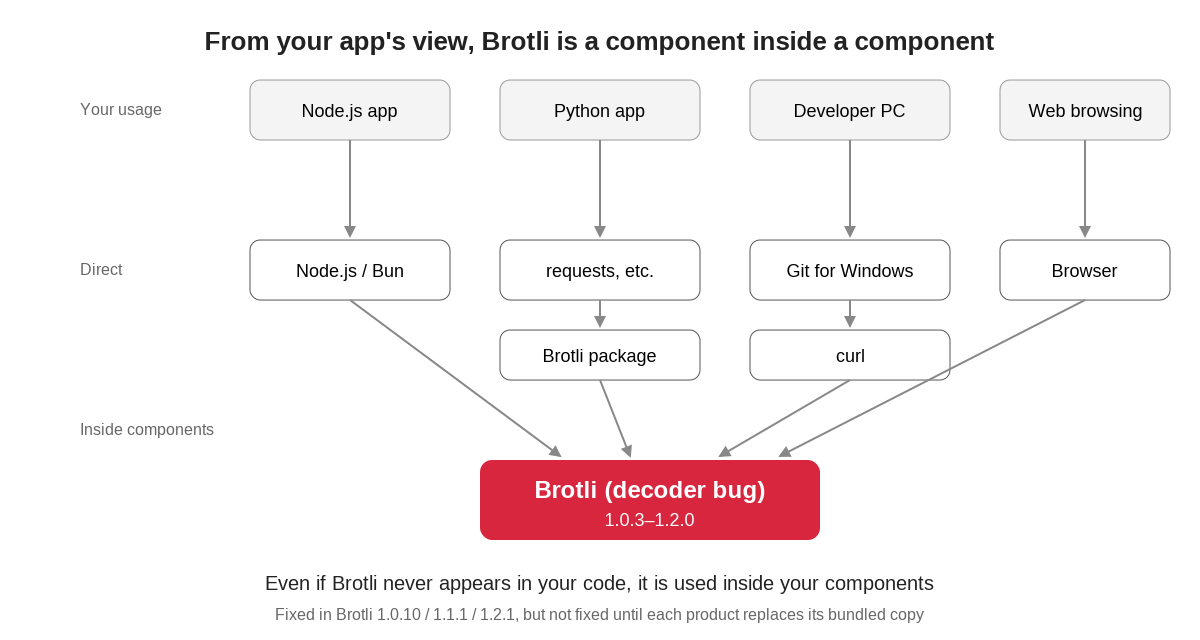
But the hole was not in Node.js itself. It was in Brotli, a compression component bundled inside Node.js. The same component was also inside Python extension packages, Git for Windows, Envoy, Bun, and web browsers.
Based on each software project's official announcements as of November 23, 2026, this article traces how far a hole in a single component spread. It then explains what a software bill of materials (SBOM) is, the tool for keeping track of these "components inside components," and what business-side owners should ask of their development partners.
Key Points
- CVE-2026-111497 is a hole in the decompression code of Brotli, Google's compression library. Node.js, Python packages, Git for Windows, Envoy, Bun, .NET, the Windows builds of PHP, and others each released fixed versions.
- Even if your own application does not use it directly, you are affected if it sits inside a component you use. This is called a transitive (indirect) dependency.
- A list of "which components contain what" is called an SBOM (software bill of materials). Japan's Ministry of Economy, Trade and Industry (METI) and the U.S. CISA have published guidance on how to create one.
What Happened
Brotli is the name of a compression format created by Google, and of the library that reads and writes it. Many servers and browsers use it to shrink web pages and images so they arrive faster.
The U.S. vulnerability database NVD describes the hole as follows.
A buffer overflow vulnerability in the Brotli decoder (c/dec/decode.c) in Google Brotli versions 1.0.3 through 1.2.0 on all platforms allows a remote unauthenticated attacker to corrupt adjacent decoder state memory, disclose sensitive memory contents, cause a denial of service, or potentially execute arbitrary code using a crafted Brotli-compressed stream.
Source: GitHub Advisory GHSA-9v8h-qqgm-4m35
The fixed versions, Brotli 1.0.10, 1.1.1, and 1.2.1, were released on October 21. On October 27, the U.S. CISA (Cybersecurity and Infrastructure Security Agency) added this CVE to its catalog of Known Exploited Vulnerabilities (KEV). The product name in that listing was not Node.js but "Google Brotli."
Because Node.js announced it first, it was called Node2Shell, but Node.js's official announcement itself describes it as "a flaw in the Brotli decoder bundled with Node.js." The software a nickname points to and the place where the hole actually lives do not always match.
Where It Was, and Who Fixed It
Here is what we could confirm from official announcements.
| Where it is embedded | How it is included | Fixed versions (official announcements) |
|---|---|---|
| Node.js | Bundled in the runtime | 22.23.4 / 24.22.1 / 26.12.1 (October 21) |
| Python | The Brotli and brotlicffi packages on PyPI | Brotli 1.2.1 / brotlicffi 1.2.1.0 (October 22–23) |
| Git for Windows | Its bundled curl uses Brotli | 2.56.0.windows.4 (October 26) |
| Envoy (network proxy) | When Brotli decompression is configured | 1.40.0 / 1.39.3 / 1.38.6 / 1.37.8 / 1.36.12 |
| Bun (JavaScript runtime) | Bundled in the runtime | 1.4.4 |
| .NET | Bundled in the runtime | 8.0.33 / 9.0.22 / 10.0.14 (October 25) |
| PHP for Windows | Reached through the cURL extension | 8.5.12-1 / 8.4.27-1 / 8.3.36-1 / 8.2.35-1 (October 26) |
| Firefox | Bundled in the browser | Already fixed in April, before disclosure |
Beyond this table, software carrying Brotli includes compression tools, PDF viewers, databases, and even UEFI components (the firmware that runs when a PC boots). Broccoli2Shell, a page that collects affected software, lists many more than those named here. The Canadian Centre for Cyber Security also wrote the following in its alert.
Because Brotli is widely integrated into other software, organizations should assess applications and products that bundle or rely on vulnerable Brotli components.
Source: Canadian Centre for Cyber Security AL26-027
"We Don't Use Node.js" Doesn't Mean You're Safe
You may not use it, but your components do
Take a Python web service as an example. When you install requests or aiohttp to call external APIs, a Brotli package may be installed along with them. According to Broccoli2Shell, in environments where a Brotli package is installed, these libraries automatically decompress Brotli-compressed responses.
The word "Brotli" never appears in the application code. Even so, if the server you connect to returns crafted data, it reaches the vulnerable decompression code.
A component that your direct components (direct dependencies) use in turn is called a transitive (indirect) dependency. For many companies, this hole sat on the transitive-dependency side.
Updating the OS may not fix it
On a Linux server, updating the OS packages also updates Brotli. But that only fixes software that uses the OS's copy of Brotli.
Software that carries its own copy of Brotli, like Node.js, Bun, .NET, and Git for Windows, has to wait for an update of that software itself. The .NET announcement says that applications distributed together with their runtime must be rebuilt with the updated SDK and redistributed.
For Git for Windows, an independent researcher's test confirmed that simply running git clone on a developer's PC decompresses the remote server's response with the bundled Brotli. Not only servers but developers' machines are in scope.
Some were "fixed without knowing"
The code fix in Brotli had already landed on February 27, eight months before disclosure. At the time it was described as a change to "detect invalid data earlier," and was not explicitly marked as a security fix.
As a result, software that regularly pulled in upstream updates was fixed without knowing it. The security information-sharing mailing list (oss-security) put it this way.
Some of these fixed it unknowingly, by pulling in updates from the Google brotli repo before the vulnerability was announced.
Source: oss-security mailing list
Firefox had received a report of this hole and fixed it in April. The habit of keeping components up to date was itself a form of protection.
SBOM: A List of What's Inside Your Components
The tool for keeping track of these "components inside components" is the SBOM (Software Bill of Materials). METI's "Guide on Introduction of SBOM for Software Management ver 2.0" (August 2024) defines it as follows.
An SBOM is a machine-processable list that includes information on software components and their dependencies. (translated)
Source: METI, "Guide on Introduction of SBOM for Software Management ver 2.0"
Like a bill of materials in manufacturing, it records "which components, in which versions, are in this product" in a form that programs can read.
In July 2026, the U.S. CISA, together with agencies from several countries including Japan's METI, revised its guidance on the minimum elements an SBOM should contain. On scope, it says:
An SBOM should include information for all components that make up the target software, including transitive dependencies. There is no minimum depth.
Source: CISA et al., "2026 Minimum Elements for a Software Bill of Materials"
A list of only your direct components will not reveal a hole like this one. Only when components inside components are listed can you answer "Which of our services contain Brotli 1.2.0?" in a few minutes.
Conversely, with an SBOM that lists every component, you can say a vulnerability in an unlisted component "doesn't affect us." You can get out of the cycle of asking your development partner every time there is news and waiting days for an answer.
What Business-Side Owners Should Ask of Their Development Partners
METI's Guide ver 2.0 presents an "SBOM transaction model" as a reference for what the client and the contractor should agree on in their contract. It includes items such as "specify whether the scope covers only directly used components or recursively includes indirectly used components" and "specify whether prior declaration and agreement are required when using third-party components (commercial components, OSS)" (translated).
You don't need to ask for everything from the start. As a business-side owner, confirming the following first will keep you from scrambling the next time the news breaks.
| What to confirm | Why it matters |
|---|---|
| Can they produce an SBOM for your service? If so, does it include indirect components? | Direct components alone won't reveal a hole like this Brotli one |
| When was the SBOM made? Is it regenerated for every release? | Components change with every update. An outdated SBOM leads to wrong decisions |
| Is updating components bundled in languages and runtimes included in the maintenance scope? | Some copies aren't fixed by OS updates. Decide who notices and who replaces them |
| Does the service automatically decompress data received from external servers? | This time, the hole was reached by receiving and decompressing crafted compressed data |
| Are developer machines and internal tools (Git, curl, etc.) also covered by updates? | Fixing only the servers leaves old components on developer machines |
| Do they rely solely on scanning tools to check for vulnerabilities? | Right after disclosure, there was a period when tools could not detect the Python packages |
The component where the next big hole is found will most likely not be in your own code either, but somewhere far beneath it. Whether you can answer "does this affect us?" from your SBOM at that moment is what determines how fast you can respond.
December 3: More Details in Our Webinar
Using vulnerability news like the cases in this article as examples, we'll cover everything from vulnerability basics to how to prepare your own services in a free 30-minute webinar (held in Japanese).
What Is a "Vulnerability," Really? Checkpoints for Your Own Services, Drawn from Real News
- Date and time: Thursday, December 3, 2026, 12:15–12:45 JST (lunchtime session; join or leave anytime)
- Format: Online (Zoom), free of charge
- Topics: What is a vulnerability, really? / Why is it in the news so much lately? / How to prepare when you see the news
- For: People at businesses responsible for their company's services or systems
- Bonus: All registrants receive the day's slides, and those who answer the survey receive a checklist of what to check when you see vulnerability news
You can also submit questions in advance through the registration form, such as "Does the vulnerability in this article affect us?"
Webinar details / Register here
Vitalify Asia develops web and mobile services and operates them after release. We have experience with the kinds of work described in this article: updating the software services rely on, responding to vulnerabilities, and reviewing operational setups. If you have any concerns about preparing your services for vulnerabilities, please feel free to contact us.
Since 2008, VFA has been involved in more than 1,000 development projects. Some of our work is not publicly listed, so please feel free to contact us for details.
Vitalify Asia's development portfolio
This article is based on each software project's official announcements, NVD, CISA's KEV catalog, and the SBOM guidance from METI and CISA. Each service's specifications are continuously updated. The content of this article is current as of November 23, 2026.
Vitalify Asia Co., Ltd. https://vitalify.asia/
Struggling to turn ideas into reality? With a proven track record of over 1,000 clients, our agile and flexible team will accelerate your business growth.