"It Runs, but It Can't Be Fixed": Languages and Middleware Past End of Support
Ruby2Shell, disclosed in November, gets no fix for Ruby 3.2 or earlier because those versions are past end of support. We list the support deadlines for PHP, Node.js, Ruby, Java, nginx, WordPress, and major operating systems from official sources, and explain the risks and how to plan a migration.

On this page
- Key Points
- What Is a Support Deadline?
- What Happened with Ruby2Shell
- Support Deadlines for Major Foundations (as of November 23, 2026)
- nginx and WordPress Don't Set Dates
- For Java, the Deadline Depends on Where You Got It
- The Risks of Running Past End of Support
- How to Approach a Migration
- What to Check in Your Own Company
- December 3: More Details in Our Webinar
On November 18, the official Ruby website published fixed releases for vulnerabilities in string handling and other areas. One of them, nicknamed "Ruby2Shell," can let an outsider take over a server under the right conditions.
The fixed releases are 4.0.10, 3.4.13, and 3.3.14. Services running Ruby 3.2 or earlier get no fix.
The reason is simple: 3.2 is already past end of support. Those services still run without any problems today. But when a hole is found, there is no longer a way to patch it.
This article lists the support deadlines for the languages, middleware, and operating systems that web services are built on, based on each project's official announcements as of November 23, 2026. It also covers the risks of running past end of support and how to approach a migration.
Key Points
- Each version of a language or middleware has a support deadline, and versions past that deadline receive no vulnerability fixes.
- As of November 2026, Ruby 3.2, Node.js 20, PHP 8.1, Amazon Linux 2, and others are already past their deadlines; PHP 8.2 reaches its deadline at the end of December, and Windows Server 2016 in January.
- Migrate in this order: inventory → a plan worked back from the deadline → testing → cutover. Deciding what to do and by when is the business owner's part.
What Is a Support Deadline?
Most languages and middleware set a support period for each version. The period is usually divided into two or three stages.
First comes a stage where both bugs and vulnerabilities are fixed. Next comes a stage where only serious vulnerabilities are fixed. After that, no fixes are released no matter what hole is found.
The official Ruby website defines the last stage like this:
eol (end-of-life): Branch is not supported by the ruby-core team any longer and does not receive any fixes.
Source: Ruby official: "Ruby Maintenance Branches"
PHP provides two years of regular support after release, followed by two years in which only serious security issues are fixed. In other words, fixes stop for every version roughly four years after release.
What Happened with Ruby2Shell
watchTowr's Ruby2Shell explainer says this about 3.2 and earlier:
Ruby 3.2 and earlier branches are end of life and will not get a fix, so organizations should move to a supported release.
Source: watchTowr: "Ruby2Shell FAQ"
No workaround has been published either. And even if you update frameworks like Rails and gems (libraries) to the latest versions, the hole remains if Ruby itself is old.
Support for Ruby 3.2 ended on April 1, 2026. So a serious vulnerability with no fix was found just seven and a half months after support ended.
Note that when support ends, no warning appears and the service does not stop. "It runs" and "it can be fixed" are two different things.
Support Deadlines for Major Foundations (as of November 23, 2026)
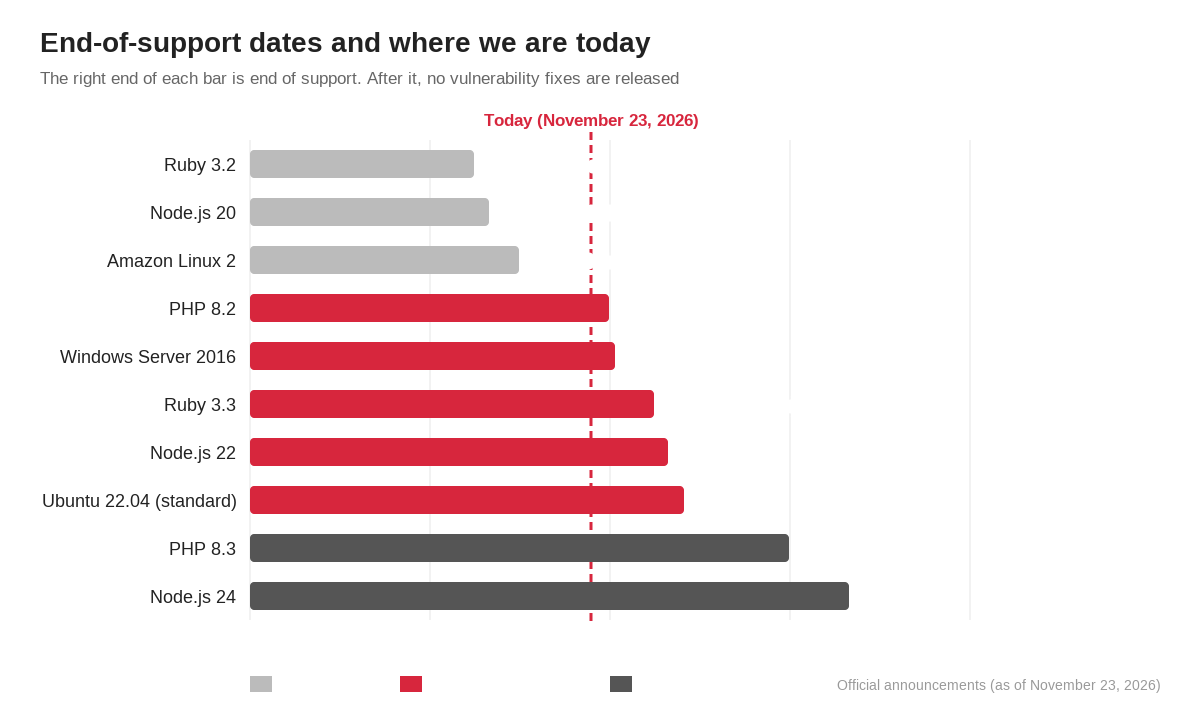
These deadlines were checked against each project's official announcements. "Ending soon" means the deadline falls roughly by the end of June 2027.
| Foundation | Past end of support | Ending soon | Current |
|---|---|---|---|
| PHP | 8.1 and earlier (8.1 ended December 31, 2025) | 8.2 (December 31, 2026) | 8.3 (December 31, 2027), 8.4 (December 31, 2028), 8.5 (December 31, 2029), 8.6 (December 31, 2030) |
| Node.js | 20 and earlier (20 ended April 30, 2026), 25 | 22 (April 30, 2027) | 24 (April 30, 2028), 26 (April 30, 2029) |
| Ruby | 3.2 and earlier (3.2 ended April 1, 2026) | 3.3 (planned for March 31, 2027) | 3.4, 4.0 (deadline not yet set) |
| nginx | 1.28 and earlier (treated as legacy; no fixes were released on November 18) | — | 1.30 (stable), 1.31 (mainline) |
| WordPress | Officially, only the latest major release is supported | — | Latest major release |
| Ubuntu | Standard support for 20.04 (ended May 2025; extended via paid Ubuntu Pro) | 22.04 (standard support until May 2027) | 24.04 (May 2029), 26.04 (May 2031) |
| Debian | 11 (LTS ended August 31, 2026) | 12 ended its regular period on July 11, 2026 and is in the LTS stage (until June 30, 2028) | 13 (August 9, 2028; LTS until June 30, 2030) |
| Amazon Linux | Amazon Linux 2 (ended June 30, 2026) | — | Amazon Linux 2023 (June 30, 2029) |
| Windows Server | — | 2016 (extended support until January 12, 2027) | 2019 (January 9, 2029), 2022 (October 14, 2031; mainstream support ended October 2026) |
Red Hat Enterprise Linux (RHEL) has a 10-year life cycle for each major version. RHEL 8 enters the extended (paid) support stage on June 1, 2029.
nginx and WordPress Don't Set Dates
nginx does not publish end dates for its versions. On the official download page, everything other than the latest mainline (1.31) and stable (1.30) is listed under "Legacy versions." The fixed releases for NGINX2Root and the other issues announced on November 18 were also only 1.31.9 and 1.30.7.
WordPress's official documentation describes the scope of its support like this:
The only current officially supported version is the last major release of WordPress. Previous major releases before this may or may not get security updates as serious exploits are discovered.
Source: WordPress official: "Supported Versions"
In practice, fixes are backported to older versions too, but the project says it does this "as a courtesy". In July 2025, it stopped security fixes for 4.1–4.6.
For Java, the Deadline Depends on Where You Got It
With Java, the same version has different deadlines depending on the distributor. You first need to check whether your Java is Oracle JDK or an OpenJDK distribution such as Eclipse Temurin or Amazon Corretto.
| Version (LTS) | Oracle JDK (Premier / Extended Support, both require a paid contract) | Eclipse Temurin (free) | Amazon Corretto (free) |
|---|---|---|---|
| 8 | March 2022 / December 2030 | At least December 2030 | December 2030 |
| 11 | September 2023 / January 2032 | At least October 2027 | January 2032 |
| 17 | September 2026 / September 2029 | At least October 2027 | October 2029 |
| 21 | September 2028 / September 2031 | At least December 2029 | October 2030 |
| 25 | September 2030 / September 2033 | At least September 2031 | October 2032 |
With Oracle JDK, you also need to watch the license terms. For Oracle JDK 21, updates released on or after October 20, 2026 moved to a license that requires a contract for commercial use (the OTN license). Non-LTS versions (such as 26) are superseded when the next version ships and receive no further updates.
The Risks of Running Past End of Support
The biggest problem is carrying a "hole with no way to fix it," as with Ruby2Shell. A problem you could solve by applying a fixed release becomes one you can't close until the migration is finished.
A migration usually takes weeks to months. Meanwhile, in examples from the past year, the time from a fixed release to confirmed exploitation has been a matter of days (5 days for PHP2Shell, 6 days for Node2Shell, based on the dates added to CISA's KEV catalog). If you start migrating only after a vulnerability is found, you stay exposed for the length of that gap.
Other things happen too:
- New libraries drop support for old versions, so you can no longer update other components either (WordPress 7.0 dropped support for PHP 7.2 and 7.3)
- Business partners' security reviews or audits flag the unsupported versions
- Fewer people know the old versions well, which raises the cost when you finally do migrate
How to Approach a Migration
A migration is not something the development company can decide on its own. By when, how far, and at what cost all require judgment from the business side.
| Stage | What the business owner decides | What development produces |
|---|---|---|
| 1. Inventory | The scope of services covered, and an owner for each service | A list of versions of languages, middleware, OS, and major libraries (including production, background-job servers, and container images) |
| 2. Plan | A target completion date worked back from the deadline, budget, and acceptable downtime windows | Choice of target versions, identification of high-impact areas, effort estimates |
| 3. Testing | Acceptance criteria (which screens and business flows must work to pass) | A test environment, automated tests, performance checks |
| 4. Cutover | Cutover date and time, notice to users, criteria for rolling back | A cutover runbook, rollback steps, post-cutover monitoring |
| 5. Prepare for the next deadline | A budget for regular updates, and whether to include it in the maintenance contract | An updated deadline list, an estimate for the next migration |
The fifth stage pays off the most. Rather than doing a big migration every few years, raising versions a little each year keeps both each round of work and the risk smaller.
What to Check in Your Own Company
| What to check | Why it matters |
|---|---|
| Can you name the versions of the languages, middleware, and OS your services use? | It's the starting point for looking up deadlines |
| Have you checked each version's support deadline against the official announcements? | Deadlines vary by version and distributor (for Java, it depends on the distributor) |
| For anything with a deadline within a year, is there a migration plan and budget? | A migration takes weeks to months |
| Does your maintenance contract cover upgrading language and OS versions? | "Application maintenance" alone can leave out upgrades to the foundation |
| If you use paid extended support, do you know its deadline and cost? | Extended support buys time; it doesn't remove the need to migrate |
December 3: More Details in Our Webinar
Using vulnerability news like the cases in this article as examples, we'll cover everything from vulnerability basics to how to prepare your own services in a free 30-minute webinar (held in Japanese).
What Is a "Vulnerability," Really? Checkpoints for Your Own Services, Drawn from Real News
- Date and time: Thursday, December 3, 2026, 12:15–12:45 JST (lunchtime session; join or leave anytime)
- Format: Online (Zoom), free of charge
- Topics: What is a vulnerability, really? / Why is it in the news so much lately? / How to prepare when you see the news
- For: People at businesses responsible for their company's services or systems
- Bonus: All registrants receive the day's slides, and those who answer the survey receive a checklist of what to check when you see vulnerability news
You can also submit questions in advance through the registration form, such as "Does the vulnerability in this article affect us?"
Webinar details / Register here
Vitalify Asia develops web and mobile services and operates them after release. We have experience with the kinds of work described in this article: updating the software services rely on, responding to vulnerabilities, and reviewing operational setups. If you have any concerns about preparing your services for vulnerabilities, please feel free to contact us.
Since 2008, VFA has been involved in more than 1,000 development projects. Some of our work is not publicly listed, so please feel free to contact us for details.
Vitalify Asia's development portfolio
This article is based on each software project's official support policies and release information, and on watchTowr's explainer. Support deadlines may change at each project's discretion. The content of this article is current as of November 23, 2026.
Vitalify Asia Co., Ltd. https://vitalify.asia/
Struggling to turn ideas into reality? With a proven track record of over 1,000 clients, our agile and flexible team will accelerate your business growth.