How Fast Should You Patch? The Days Between a Fix and Its Exploitation
How many days do you have to apply a fix? In 2026, PHP2Shell hit CISA's exploited list 5 days after its fix, Node2Shell after 6. The U.S. government has replaced its uniform 2-week deadline with a rule that can require 3 days. Here is a decision table for setting patch deadlines.


On this page
You saw vulnerability news and confirmed that a fixed version is out. So by when should you apply it? Many people in charge have answered, "At the next scheduled maintenance."
Over the past year, the premise behind that answer has changed. The time between a fix's release and its use in attacks has shrunk from weeks to days. In June 2026, the U.S. government also rewrote the update-deadline rules it imposes on its own agencies.
Based on official announcements and research reports as of November 23, 2026, this article lays out how many days pass between a fix and exploitation, and how to set your own company's update deadlines.
Key Points
- In 2026's "X2Shell" cases, vulnerabilities were added to the U.S. CISA list of "actually exploited vulnerabilities" (KEV) within 2 to 6 days of the fix being released.
- The U.S. government dropped its uniform "within 2 weeks" rule. Its new rule sets deadlines ranging from 3 days to the next scheduled update, depending on whether a system is exposed to the internet, whether exploitation has been confirmed, and how far an attacker can take control.
- If your company decides its deadlines with the same four questions in advance, you won't have to agonize every time the news breaks.
How Many Days from Fix to Exploitation?
Here are the numbers for five of the "X2Shell" vulnerabilities covered in our previous article. Fix release dates come from each project's official announcements, and KEV listing dates were checked against the KEV data published by CISA (version of November 20, 2026).
| Nickname | Fix released | Added to KEV | Days |
|---|---|---|---|
| React2Shell | December 3, 2025 | December 5 | 2 days |
| wp2shell | July 17, 2026 | July 21 | 4 days |
| PHP2Shell | October 21 | October 26 | 5 days |
| Node2Shell | October 21 | October 27 | 6 days |
| NGINX2Root | November 18 | Not listed (as of November 20) | ― |
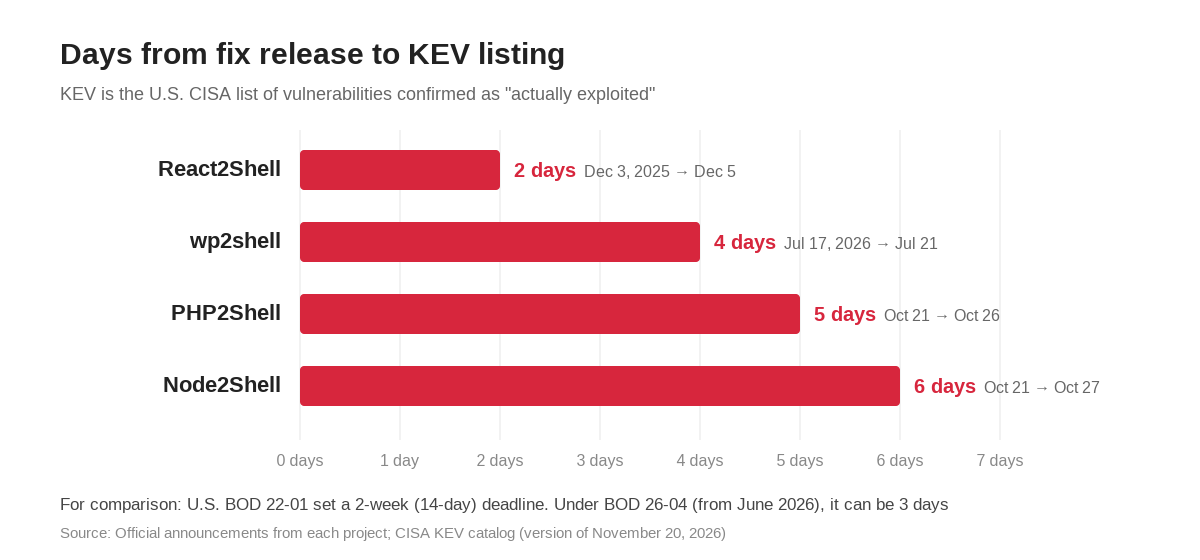
KEV is a list of vulnerabilities that CISA (the U.S. Cybersecurity and Infrastructure Security Agency) has confirmed were "actually used in attacks." The listing date is the day CISA added the entry; attacks may have started earlier. So the numbers in the table are a guide meaning "attacks were happening by this point at the latest."
NGINX2Root is not in KEV yet. However, on the same day it was disclosed, multiple researchers announced that they had built working exploit code. CyberScoop, which reported it, wrote:
Security researchers disclosed five vulnerabilities Tuesday in NGINX, ... each with a working exploit.
Source: CyberScoop
Research Reports Show the Window Shrinking, Too
The same trend shows up not only in individual incidents but in the statistics.
Google's security unit Mandiant measures the average time it takes for vulnerabilities to be exploited (Time-to-Exploit) every year. It was 63 days in 2018–2019, 32 days in 2021–2022, and just 5 days in 2023.
Through 2018 to 2019, we observed an average TTE of 63 days. ... In 2023, we observed the largest drop in TTE thus far, with an average of just five days.
Source: Google Cloud (Mandiant), "Time-to-Exploit Trends 2023"
That 5-day figure is an average that excludes 15 extreme outliers; including them, it is 47 days. Even so, looking only at attacks after a fix was available (n-days), 12% were exploited within 1 day, 29% within 1 week, and 56% within 1 month.
Cases where attacks begin before a fix exists are also increasing. According to vulnerability intelligence company VulnCheck, of the vulnerabilities confirmed as exploited in the first half of 2025, 32.1% had evidence of exploitation on or before the day their CVE number was published. In 2024, the figure was 23.6%.
On the other hand, not every vulnerability gets targeted. CISA says fewer than 4% of vulnerabilities assigned CVE numbers have been confirmed as exploited. But of that 4%, 42% were used on the day of disclosure, and half within 2 days. You don't need to rush everything; identify what will be targeted and move in days for just those. That is the premise behind how update deadlines are thought about today.
The U.S. Government Dropped "2 Weeks for Everything"
U.S. federal agencies are subject to binding directives (BODs) issued by CISA.
BOD 22-01, issued in 2021, required agencies to fix vulnerabilities listed in KEV within 2 weeks if they were assigned numbers in 2021 or later. That "2 weeks" figure has often been cited in the private sector as a benchmark for update deadlines.
On June 10, 2026, CISA replaced it with BOD 26-04.
This Directive supersedes and hereby revokes BOD 19-02 ... and BOD 22-01
Source: CISA, "BOD 26-04"
The new directive sets deadlines using four questions:
- Can the device or system be reached from the internet without authentication?
- Is the vulnerability listed in KEV?
- Can every step of the attack be automated?
- If attacked, can the attacker control only part of the system, or take it over completely?
Depending on the combination, deadlines fall into four tiers: "3 days," "14 days," "60 days," and "at the next scheduled update." For the most urgent combinations, it requires not only a fix within 3 days but also an investigation (forensics) into whether the system has already been compromised. The days are calendar days, so weekends count.
According to the KEV data, of the 306 entries newly added in 2026, 166 had a deadline 3 days after listing. Two weeks is no longer the "urgent" deadline.
BODs are directives for U.S. government agencies, and companies in Japan have no obligation to follow them. Even so, as a table published by a public agency showing how many days apply under which conditions, it is a good model when creating your own company's standards.
A Decision Table for Your Company's Update Deadlines
The deadline table in BOD 26-04 (Table 1) sets a deadline for each of 16 combinations. The table below merges rows with the same result and rephrases the terms for businesses. The numbers are unchanged from the U.S. directive, so use them as a guide when creating your own standards.
The four questions in the table mean the following:
- Exposed to the internet?: Can the device or system be reached from outside the company without logging in? Anything used only inside the corporate network or behind a VPN is "internal only."
- Exploitation confirmed?: Has it been confirmed as used in real attacks? You can tell from a KEV listing or announcements by the vendor or JPCERT/CC.
- Can the attack be automated?: Can a program attack one target after another without a person doing the work? If so, it can spread to many devices at once.
- Does it reach full takeover?: If attacked, is the whole system controlled, or is it limited to some operations or a data leak?
| Exposed to the internet? | Exploitation confirmed? | Can the attack be automated? | Reaches full takeover? | Update deadline |
|---|---|---|---|---|
| Exposed | Confirmed | Either | Yes | Within 3 days; also check for signs of intrusion |
| Exposed | Confirmed | Yes | Partial only | Within 3 days |
| Exposed | Confirmed | No | Partial only | Within 14 days |
| Exposed | Not yet | Yes | Yes | Within 3 days |
| Exposed | Not yet | No | Yes | Within 14 days |
| Exposed | Not yet | Yes | Partial only | Within 14 days |
| Exposed | Not yet | No | Partial only | Within 60 days |
| Internal only | Confirmed | Yes | Yes | Within 3 days; also check for signs of intrusion |
| Internal only | Confirmed | Yes | Partial only | Within 14 days |
| Internal only | Confirmed | No | Either | Within 14 days |
| Internal only | Not yet | Yes | Either | Within 60 days |
| Internal only | Not yet | No | Either | At the next scheduled update |
Even for an "internal only" system, if exploitation is confirmed, the attack can be automated, and it reaches full takeover, the deadline is 3 days. Once an attacker gets inside through an email attachment or a stolen VPN password, a hole that can be exploited automatically spreads quickly to other devices on the internal network. Being internal only is a reason to extend the deadline, but for a hole that is already being exploited, that grace period is nearly gone.
If you can't tell whether the attack can be automated, treat it as "yes" and go with the shorter deadline.
There are three things to keep in mind when using the table.
- The deadline starts from whichever is earliest: the fix's release, its KEV listing, or the day your company noticed. BOD 26-04 also counts from the earlier of the listing date and the detection date.
- Deadlines change when the situation changes. If exploitation is confirmed, switch to the shorter deadline from that day. Conversely, if you can't apply the fix right away, you can buy time by taking the system off the internet or disabling the feature, turning "exposed" into "internal only." BOD 26-04 also lists removing systems from the internet as a valid mitigation.
- Three days is not enough time to go looking for the person in charge on a weekday. You need to decide who makes the call, who applies the fix, and who verifies it before the news breaks.
What to Check at Your Company
| What to check | Why it matters |
|---|---|
| Can you list your internet-exposed systems separately from internal-only ones? | If you can't answer the decision table's first question, you'll have to work to the shortest deadline for everything |
| Have you decided where to check for exploitation (CISA's KEV, JPCERT/CC and IPA alerts, vendor announcements)? | A single report that "exploitation is confirmed" changes the deadline |
| Can your process handle an update within 3 days, even over a weekend? | The most urgent deadline is counted in calendar days |
| Do your maintenance or operations outsourcing contracts specify update deadlines? | A contract that only says "at the next scheduled maintenance" won't meet a 3-day update |
| Do you have procedures for taking systems off the internet or disabling features when you can't apply a fix right away? | They buy time until the fix is applied |
| Who checks for intrusion after the fix is applied? | For vulnerabilities with confirmed exploitation, attackers may have gotten in before the fix |
Update deadlines are no longer something you decide after the news breaks. Aim for a state where the four questions and their deadlines are set in advance, and when news breaks, you simply apply it to the table.
December 3: More Details in Our Webinar
Using vulnerability news like the cases in this article as examples, we'll cover everything from vulnerability basics to how to prepare your own services in a free 30-minute webinar (held in Japanese).
What Is a "Vulnerability," Really? Checkpoints for Your Own Services, Drawn from Real News
- Date and time: Thursday, December 3, 2026, 12:15–12:45 JST (lunchtime session; join or leave anytime)
- Format: Online (Zoom), free of charge
- Topics: What is a vulnerability, really? / Why is it in the news so much lately? / How to prepare when you see the news
- For: People at businesses responsible for their company's services or systems
- Bonus: All registrants receive the day's slides, and those who answer the survey receive a checklist of what to check when you see vulnerability news
You can also submit questions in advance through the registration form, such as "Does the vulnerability in this article affect us?"
Webinar details / Register here
Vitalify Asia develops web and mobile services and operates them after release. We have experience with the kinds of work described in this article: updating the software services rely on, responding to vulnerabilities, and reviewing operational setups. If you have any concerns about preparing your services for vulnerabilities, please feel free to contact us.
Since 2008, VFA has been involved in more than 1,000 development projects. Some of our work is not publicly listed, so please feel free to contact us for details.
Vitalify Asia's development portfolio
This article is based on CISA's directives (BOD 22-01 and BOD 26-04) and KEV catalog, research reports from Google Cloud (Mandiant) and VulnCheck, and each software project's official announcements. The content of this article is current as of November 23, 2026.
Vitalify Asia Co., Ltd. https://vitalify.asia/
Struggling to turn ideas into reality? With a proven track record of over 1,000 clients, our agile and flexible team will accelerate your business growth.