Why "X2Shell" Keeps Happening: What These Recent Vulnerabilities Really Are, and What to Check at Your Company
React2Shell, PHP2Shell, Node2Shell, Java4Shell, NGINX2Root: "X2Shell" vulnerabilities keep coming. Different names, same core: data sent from outside lets attackers run commands in the software beneath your app. Here's what they share and what to check.

On this page
- Key Points
- What "2Shell" Means
- Recent "X2Shell" Vulnerabilities
- Three Things They Have in Common
- 1. The hole is in the "foundation," not your own code
- 2. Features you don't think you use become the entry point
- 3. Combinations raise the damage a level
- Why So Many, So Recently?
- What Business-Side Owners Should Check
- December 3: More Details in Our Webinar
React2Shell, wp2shell, PHP2Shell, Node2Shell, Java4Shell. And this week, NGINX2Root.
Over the past year, names like "X2Shell" have filled the vulnerability news. React, WordPress, PHP, Node.js, Java, nginx: the building blocks most commonly used in web services have almost all had their turn.
Judging by the names alone, they look like separate incidents, but line them up and they are strikingly similar. Based on each software project's official announcements as of November 20, 2026, this article explains what "X2Shell" really is and what people responsible for their company's services should check.
Key Points
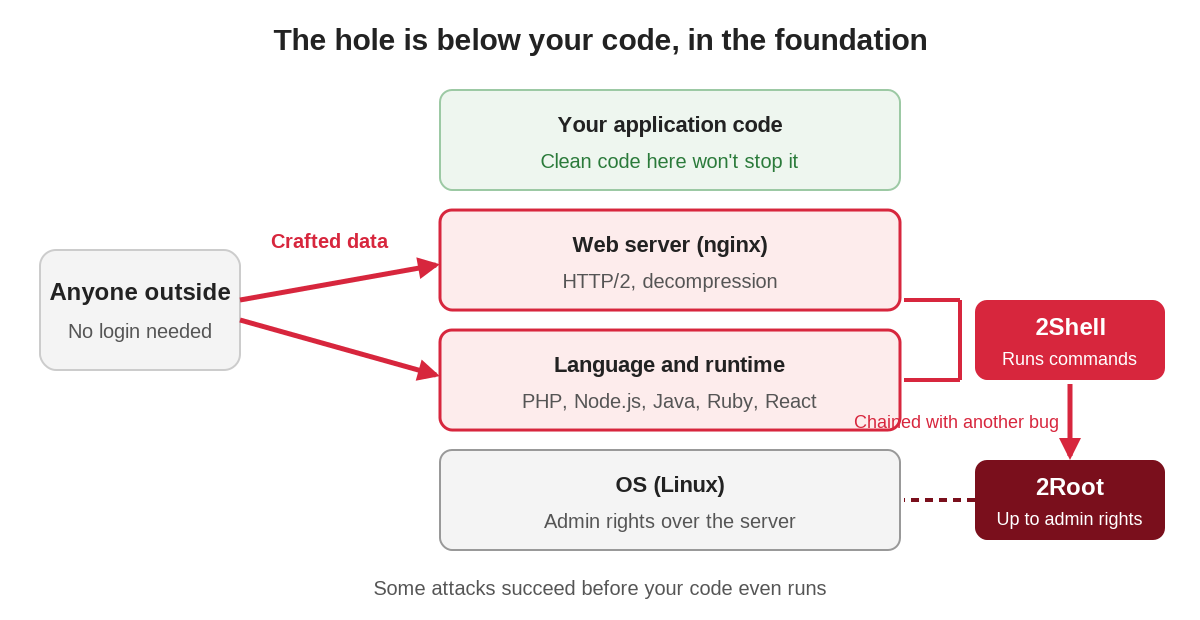
- "X2Shell" is a nickname for vulnerabilities that let an attacker run commands on the server where the software runs (in other words, "get a shell") just by sending data from outside. "2Root" refers to ones that go further and reach the server's administrator privileges.
- The hole is not in code your company wrote, but in the languages, libraries, and web servers running beneath it. Some attacks succeed before your own code even runs.
- The core of defense is being able to say which versions of these foundations you use, and having a setup that can swap in fixed versions within days of release.
What "2Shell" Means
A "shell" is the window through which commands are typed into a server. "Getting a shell" means an attacker can run any program they like on that server. The technical term is "remote code execution (RCE)."
"X2Shell" is wordplay on "from X (the software's name) to (2) Shell." Since Log4Shell in 2021 (a vulnerability in a Java logging component), serious RCEs have tended to get names like this. The official names are numbers like CVE-2026-109618, but since numbers are hard to remember, discoverers and the press give them nicknames.
"2Root" is one step further. Root means administrator privileges on the server; once taken, everything on that server can be viewed and rewritten.
Recent "X2Shell" Vulnerabilities
Cross-checking the official announcements against the list of vulnerabilities that the U.S. CISA (Cybersecurity and Infrastructure Security Agency) has confirmed as "actually exploited" (KEV), here is the picture as of November 20, 2026.
| Nickname | Where the hole is | What it is | Fixed versions | Exploitation confirmed (KEV) |
|---|---|---|---|---|
| React2Shell | React Server Components | Flaw in restoring (deserializing) received data | 19.0.1 / 19.1.2 / 19.2.1 (December 2025) | Listed (December 5, 2025) |
| wp2shell | WordPress core | Combination of a REST API mix-up and SQL injection | 7.0.2 / 6.9.5 and others (July 2026) | Listed (July 21) |
| PHP2Shell | PHP itself | Two memory-handling flaws. Exploitable before application code runs | 8.5.12 / 8.4.27 / 8.3.36 / 8.2.35 (October 21) | Listed (October 26) |
| Node2Shell | Decompression of the Brotli compression format (Node.js and others) | Flaw in memory writes during decompression | Node.js 26.12.1 / 24.22.1 / 22.23.4 (October) | Listed (October 27, under the Brotli name) |
| Java4Shell | OpenJDK (the Java runtime) | Memory corruption in Base64 decoding | November security update (November 17) | Not listed |
| Ruby2Shell | Ruby itself | Memory overflow when converting case in some character encodings. Conditional, and one level lower in severity (CVSS 7.4) | 4.0.10 / 3.4.13 / 3.3.14 (November 18). No fix for 3.2 and earlier | Not listed |
| NGINX2Root | nginx (5 issues across 4 features, including HTTP/2) | Flaw in calculating HTTP/2 traffic volume that corrupts memory | 1.30.7 / 1.31.9 (November 18) | Not listed (working exploits reported) |
Ruby2Shell is a name given by its discoverer, Veria Labs, following PHP2Shell. Ruby's official announcement does not use this name; it was published before CVE numbers were assigned and refers to GitHub advisory IDs. Nicknames are just labels someone made up, so when checking, rely on official announcements and CVE numbers.
Ruby2Shell affects only applications that handle incoming strings in single-byte encodings such as ISO-8859-1 and convert them to upper or lower case. The conditions are narrower than the others, but security firm watchTowr says Rails and Sinatra are affected even with default settings.
Not being in KEV is no reason to relax. PHP2Shell was added to KEV 5 days after its fix was released, and Node2Shell after 6 (KEV).
Three Things They Have in Common
1. The hole is in the "foundation," not your own code
Everything in the list is foundational software for services: language runtimes, execution environments, web servers. No matter how carefully your development team writes code, a hole in the foundation leaves you just as exposed.
PHP's official announcement describes the two issues this way:
PHP 8.5.12, 8.4.27, 8.3.36 and 8.2.35 fix two critical vulnerabilities that can allow unauthenticated remote code execution.
Source: php.net
"Unauthenticated" means anyone, without even logging in.
Holes in the foundation are not fixed by updating the application. watchTowr writes about Ruby2Shell:
Updating application gems or frameworks alone does not fix it.
Source: watchTowr: Ruby2Shell FAQ
Even if a framework like Rails is up to date, the hole remains if the Ruby underneath is old. The response is not finished until you rebuild not only the servers but also background-job servers and container images, and restart them.
2. Features you don't think you use become the entry point
Node2Shell's hole was in the code that decompresses the Brotli compression format. Even if you don't recall using Brotli in your application, you can't rest easy. Node.js's fetch() automatically decompresses Brotli-compressed responses, and Express 5 automatically decompresses requests sent in that format (according to Aikido's write-up).
NGINX2Root, too, applies simply if HTTP/2 is enabled. HTTP/2 is a standard setting on today's web and is enabled on many servers.
Whether you can say "we don't use that feature" can't be known without looking inside your configuration and libraries.
3. Combinations raise the damage a level
Xint, which found NGINX2Root, reports that by combining the nginx hole with a separate hole in the Linux kernel (the core of the OS), it was able to get root on the server. It says the attack reached the outer host even when nginx ran inside a container (Docker).
wp2shell, too, became an RCE by combining two holes: a REST API mix-up and SQL injection. Holes that are "moderate" on their own can lead to the worst outcome when chained. Components like Pack2TheRoot, found this April (a hole in a Linux package management component that lets a logged-in ordinary user become root), also become material for such combinations.
Why So Many, So Recently?
One reason is that AI has sped up the search for weaknesses. AI can now help with reading code and finding suspicious spots, making even large software such as language runtimes easier to examine. Tools available to defenders are available to attackers too.
Another is that the time from fix to exploitation has shrunk. When a fix is released, working out where the hole is from the diff and writing attack code now happens faster. For NGINX2Root, several researchers announced working attack code on the same day as the disclosure.
The impact has been felt in Japan as well. According to a roundup by piyolog, with PHP2Shell, at least 246 organizations in Japan temporarily suspended their services, or announced suspensions, after the fixed versions were pre-announced.
What Business-Side Owners Should Check
| What to check | Why it matters |
|---|---|
| Can you immediately say which languages, libraries, and web servers your services use, and their versions? | It is the starting point for judging "does this affect us?" when you see the news |
| Are the versions of your languages and web servers still within their support period? | Out-of-support versions get no fixes (for Ruby2Shell, 3.2 and earlier have neither a fix nor a workaround) |
| When a fix is released, is it decided who makes the call and who swaps it in? | In an era where exploitation follows within days, spending a week finding the owner is too late |
| Do your maintenance or operations outsourcing contracts cover updates to the foundational software? | "Application maintenance" alone may leave language and web server updates out |
| When a hosting provider or SaaS says "we've resumed service," do you confirm the fix was actually applied? | Resuming service and applying the fix are separate things |
| Do you know which features you don't use (HTTP/2, Brotli, legacy character encodings, etc.)? | The entry point is often a feature you don't think you use |
Even if none of the items in the list apply to you, the next "X2Shell" will come. What matters is not memorizing individual vulnerabilities, but being ready to answer "does this affect us?" and "when can we fix it?" when one arrives.
December 3: More Details in Our Webinar
Using vulnerability news like the cases in this article as examples, we'll cover everything from vulnerability basics to how to prepare your own services in a free 30-minute webinar (held in Japanese).
What Is a "Vulnerability," Really? Checkpoints for Your Own Services, Drawn from Real News
- Date and time: Thursday, December 3, 2026, 12:15–12:45 JST (lunchtime session; join or leave anytime)
- Format: Online (Zoom), free of charge
- Topics: What is a vulnerability, really? / Why is it in the news so much lately? / How to prepare when you see the news
- For: People at businesses responsible for their company's services or systems
- Bonus: All registrants receive the day's slides, and those who answer the survey receive a checklist of what to check when you see vulnerability news
You can also submit questions in advance through the registration form, such as "Does the vulnerability in this article affect us?"
Webinar details / Register here
Vitalify Asia develops web and mobile services and operates them after release. We have experience with the kinds of work described in this article: updating the software services rely on, responding to vulnerabilities, and reviewing operational setups. If you have any concerns about preparing your services for vulnerabilities, please feel free to contact us.
Since 2008, VFA has been involved in more than 1,000 development projects. Some of our work is not publicly listed, so please feel free to contact us for details.
Vitalify Asia's development portfolio
This article is based on each software project's official announcements, CISA's KEV catalog, and piyolog's roundups. Each service's specifications are continuously updated. The content of this article is current as of November 20, 2026.
Vitalify Asia Co., Ltd. https://vitalify.asia/
Struggling to turn ideas into reality? With a proven track record of over 1,000 clients, our agile and flexible team will accelerate your business growth.