
Claude SEO for Digital Marketing: 5 Touchpoints That Optimize Your Entire Content Workflow

This article was written by a Vietnamese engineer at VFA. The original version is available here in Vietnamese.
Digital marketers today can no longer stop at getting a website onto Google.
Content also needs to appear in Google AI Overviews, ChatGPT and other AI-powered search tools. Websites must load fast, display well on mobile, carry accurate structured data, and avoid breaking after every update.
The real problem, however, is this: most marketing teams still run SEO manually and in a fragmented way.
A single article may require reviewing the title, meta description, headings, canonical, schema, alt text, internal links, Core Web Vitals and dozens of other elements. As the volume of articles grows, keeping quality consistent becomes extremely difficult.
It is against this backdrop that Claude SEO emerged as a way to standardize and automate the SEO checking process, rather than relying on a manual checklist alone.
It is an open-source SEO toolkit that runs on Claude Code, made up of 25 skills and 18 dedicated agents. The value of Claude SEO, however, does not lie in the number of commands, but in how it changes the entire marketing workflow.
Before getting into the details, there are 4 key questions every digital marketer needs to answer:
- Which command should be used at each stage?
- Which parts of the current process can the tool replace?
- How do the outputs support marketing decisions?
- How can it be integrated without complicating the system?
This article follows exactly that logic: what the tool really is → why it is needed → how to integrate it into a real workflow.
Claude SEO is not an AI writing tool
Before discussing applications, one common misconception needs clearing up: Claude SEO is not a content generation tool.
Many people assume it is an advanced AI writer. In reality, Claude SEO was not designed to replace copywriters, content writers or SEO specialists.
Its main role is to:
Check – analyze – orchestrate SEO tasks across the entire content system.
To make the structure easier to understand, Claude SEO operates through three interconnected layers, as illustrated in the diagram below. Each layer has a distinct role, but all three work together as part of a unified workflow:
- Layer 1 — Instruction: Defines what needs to be processed, the scope of the analysis, and the criteria that should be checked. For example, when a user asks Claude SEO to review an article on a staging environment, this layer identifies the target URL and the elements to review, such as the title, meta description, headings, canonical tag, schema, and images.
- Layer 2 — Orchestration: Based on the requirements defined in Layer 1, the system selects the appropriate components to carry out the work. At this layer, a Skill provides the instructions and rules that define how each element should be checked, while Agents act as independent “workers” that are selected and assigned to handle specific tasks.
- Layer 3 — Execution: Once the agents have been selected and assigned their tasks in Layer 2, they begin collecting data, checking pages, and sending their findings back to the system, where the results are consolidated into a report.
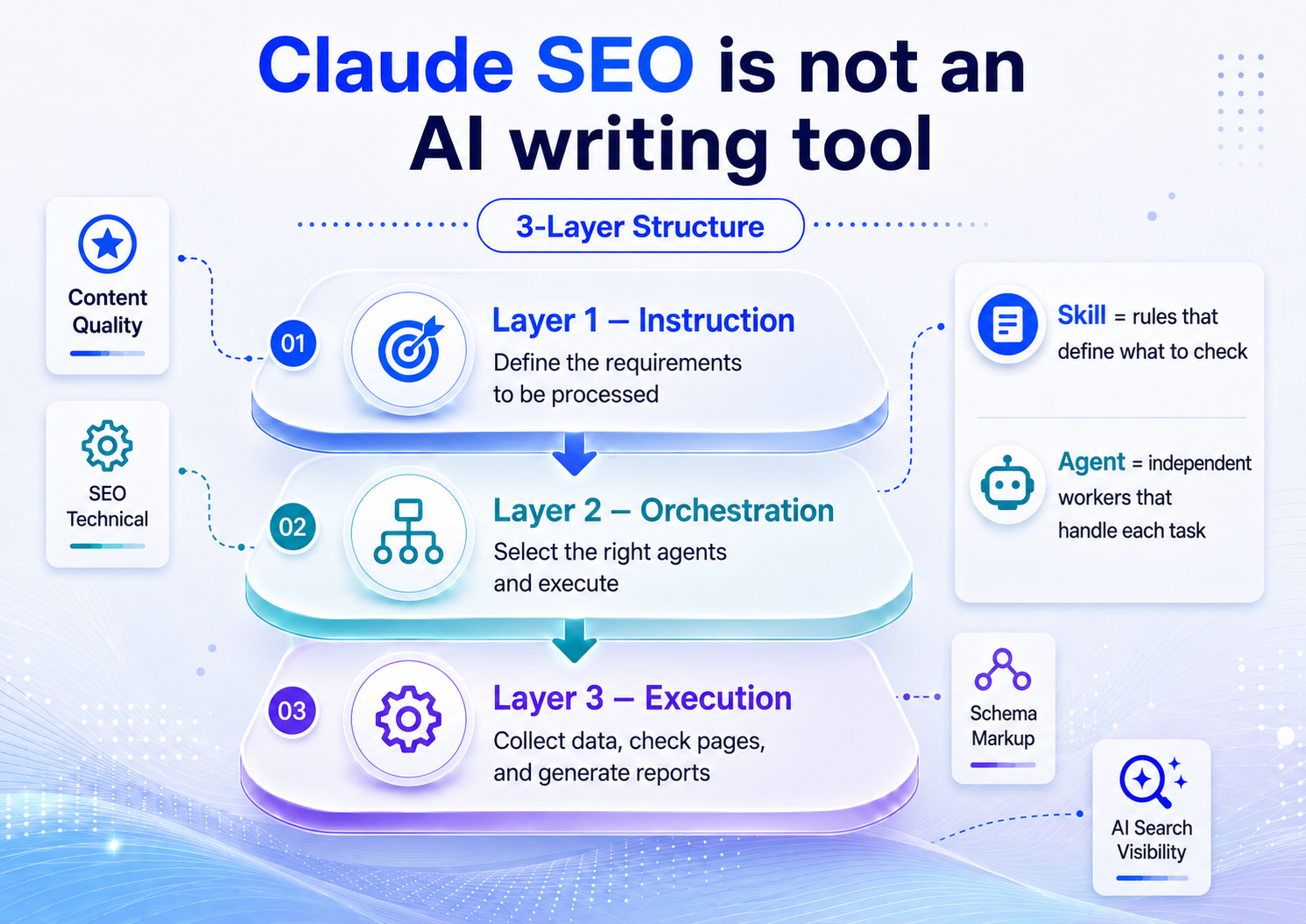
Thanks to this structure, a single audit can check the following simultaneously:
- Technical SEO
- Content quality
- Schema
- Sitemap
- Page performance
- Mobile experience
- Visibility in AI Search
The key point here is: instead of juggling several disconnected tools, the whole process is consolidated into one unified workflow.
And this is the foundation for understanding why Claude SEO can change the way marketing works.
Why should digital marketers care about Claude SEO?
To understand the tool’s value, it helps to return to a familiar reality:
Most content campaigns do not fail because there are too few articles.
They fail because:
- Content lacks a clear topical structure
- Briefs do not reflect the actual search intent
- Technical errors go undetected before publishing
- The website changes and nobody knows how SEO was affected
In other words, the problem is not “content production”, it is content operations.
Claude SEO addresses this by acting on 4 key points in the marketing workflow.

1. Standardizing content quality
Instead of each person checking in their own way, every article is evaluated against the same set of criteria.
This helps:
- Reduce dependence on individuals
- Limit mistakes caused by subjectivity
- Keep quality consistent across all content
2. Cutting manual review time
Elements such as title, meta, headings, schema, images and hreflang are checked automatically.
This allows the marketing team to:
- Skip opening every page for a manual check
- Spend less time on QA before publishing
- Focus on strategy instead of execution
3. Connecting SEO to the whole marketing process
Claude SEO does not stop at technical audits.
It also supports:
- Building content briefs
- Grouping keywords
- Analyzing competitors
- Planning content
- Optimizing the search experience
This means SEO is no longer “the final step”, but part of the marketing strategy from the very beginning.
4. Tracing the cause of traffic changes
One of the biggest benefits is the ability to track SEO changes over time.
Instead of saying:
Traffic dropped because of the algorithm
You can know exactly that:
- A canonical went missing
- Schema was edited
- A redirect is wrong
- A group of pages was affected after a deploy
This shifts the work from “guessing” to “diagnosing”.
How Claude SEO fits into the marketing workflow
Once the problem and the value are clear, the next question is:
How do we bring it into a real process without complicating the team?
The answer: do not use all 25 skills from day one.
Instead, Claude SEO should be attached to 5 natural touchpoints in your current workflow.
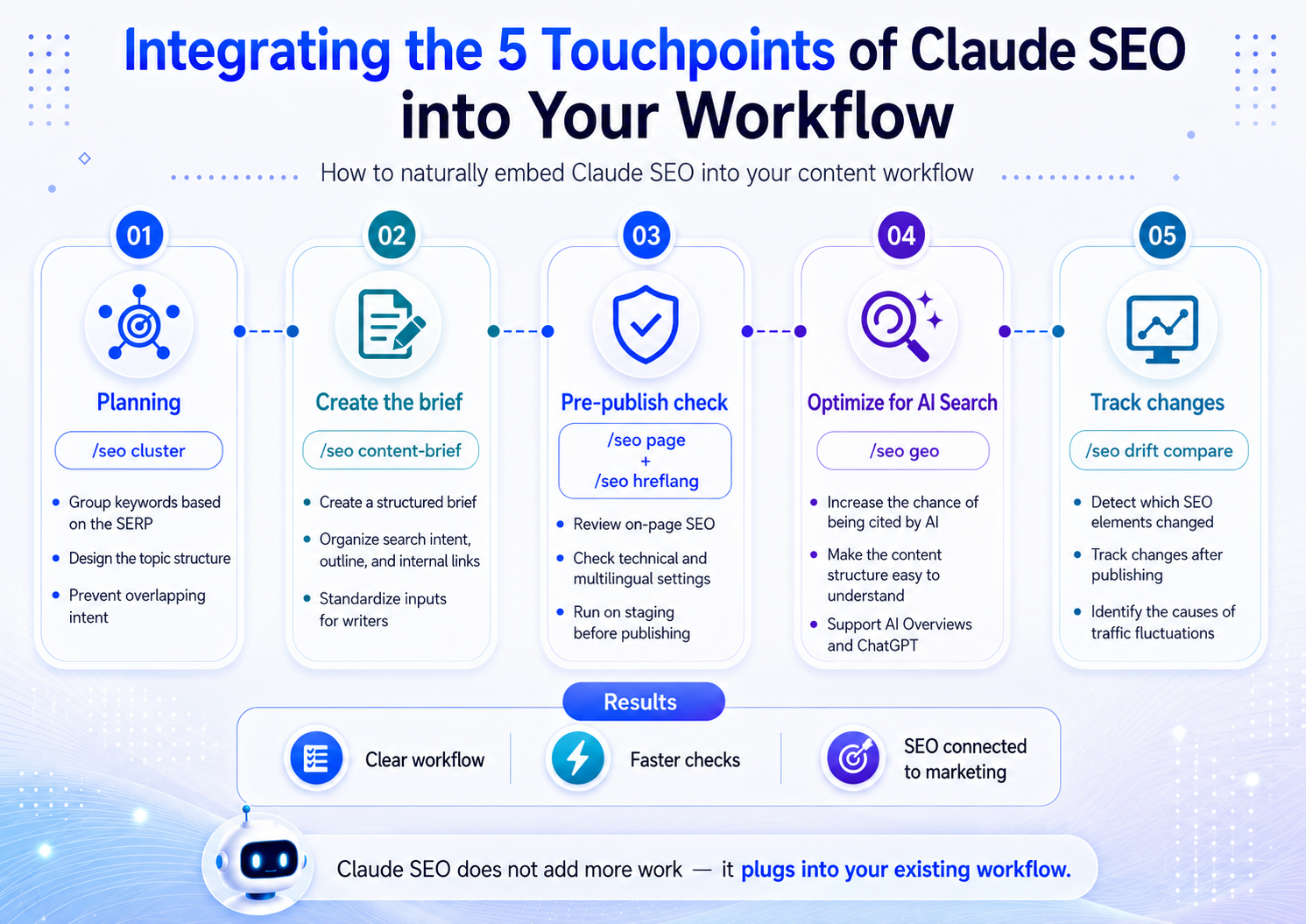
The important part: these commands do not create a new process, they “plug into” the existing one.
The 5 touchpoints in real operations
Touchpoint 1: Planning content with SERP data
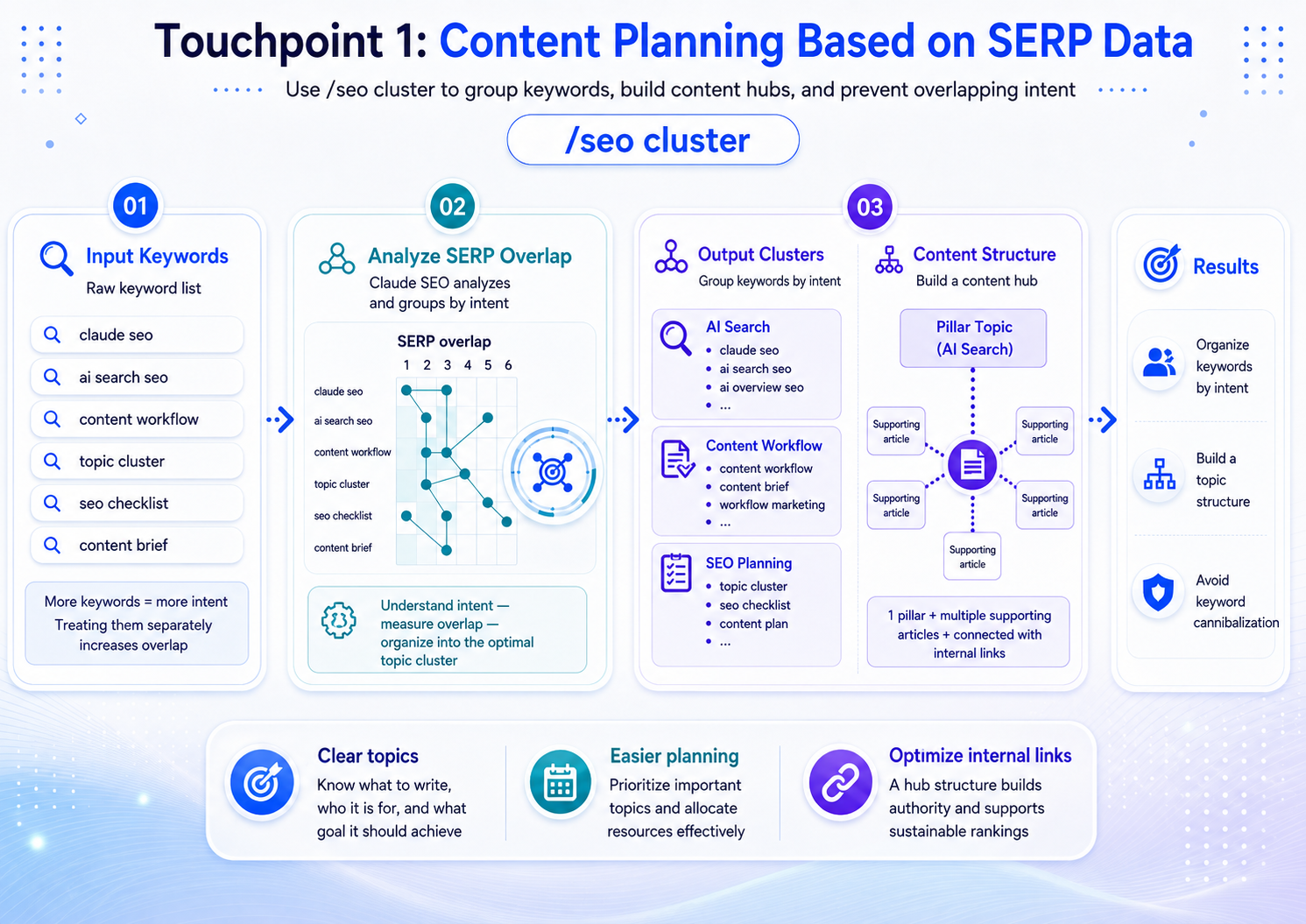
A common problem for content teams is starting from a keyword list without knowing how to group it.
The result:
- Keyword cannibalization
- Content with overlapping intent
- Or articles that are too broad and unfocused
The /seo cluster command solves this by analyzing SERP overlap.
The output helps the team:
- Know which keywords should be merged
- Which keywords need their own landing page
- Build a sensible content hub
👉 This is the shift from a “keyword list” to a “content architecture”.
Touchpoint 2: Creating a structured content brief
Weak briefs are the main reason content has to be revised again and again.
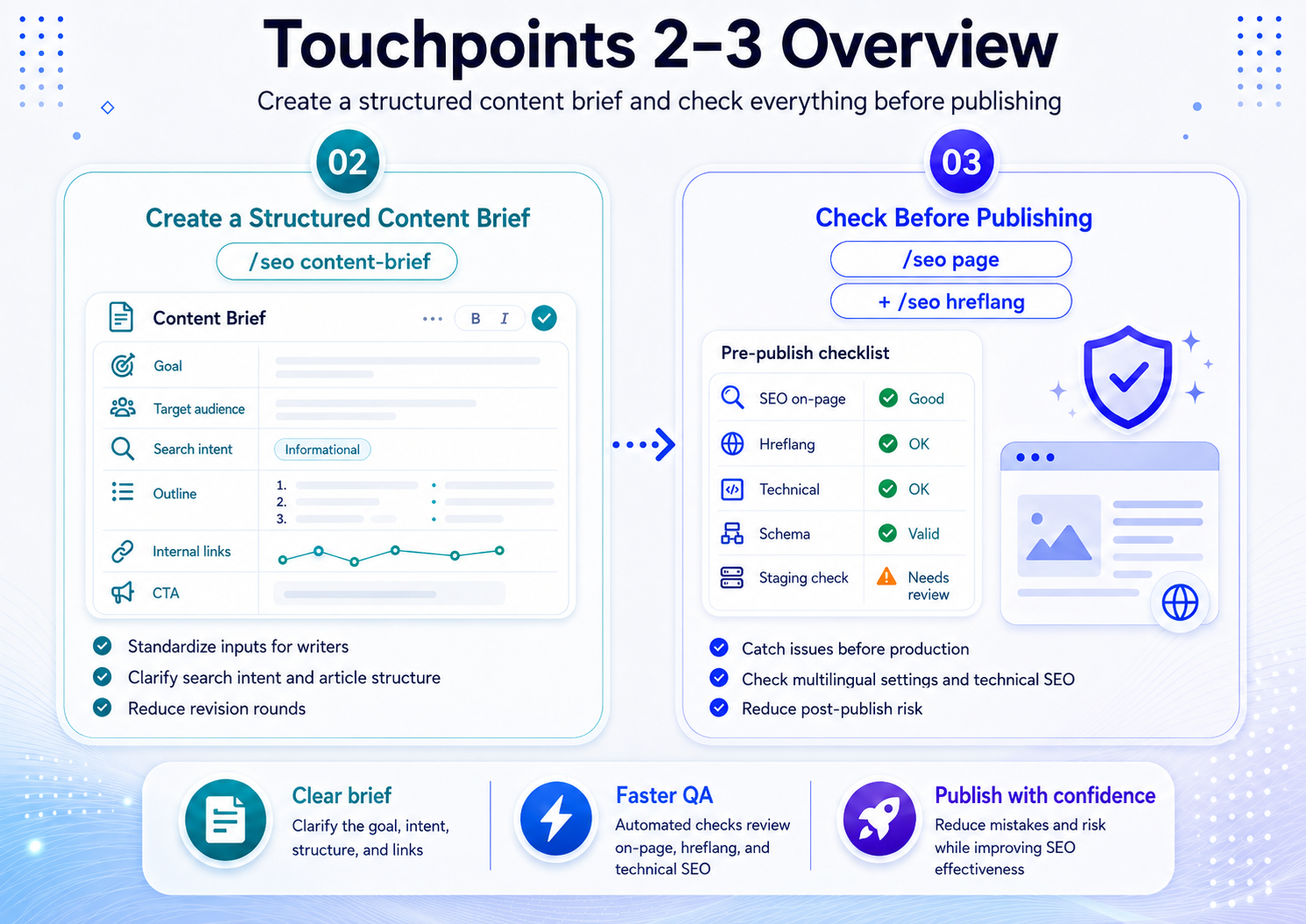
The /seo content-brief command builds a foundation covering:
- Search intent
- Outline
- Suggested internal links
- Competitor angles
That said, this is only the technical framework.
The marketing team still needs to add:
- Customer insight
- Business objectives
- Brand messaging
- CTA
👉 Claude SEO does not replace marketing thinking, it helps “shape the structure of the input”.
Touchpoint 3: Checking before publishing
The biggest mistake is only checking SEO after publishing.
The /seo page command checks ahead of time on staging:
- Meta
- Headings
- Schema
- Canonical
- Core Web Vitals risk
For multilingual websites, /seo hreflang helps avoid:
- Wrong language mapping
- Missing URL counterparts
- Indexing the wrong version
👉 This is the step that “stops errors before they reach production”.
Touchpoint 4: Optimizing for AI Search
Search is no longer just Google.
Users are asking ChatGPT, Claude and AI Overviews.
The /seo geo command evaluates:
- Citation potential
- Q&A-style structure
- How clear the content is
- Entity consistency
More importantly:
There is no need to rewrite the content, it only has to be “easy to understand and easy to cite”.
Touchpoint 5: Tracking changes after publishing
SEO does not end when an article goes live.
The /seo drift command tracks:
- Canonical
- Schema
- Internal links
- Indexability
- Redirects
The greatest strength:
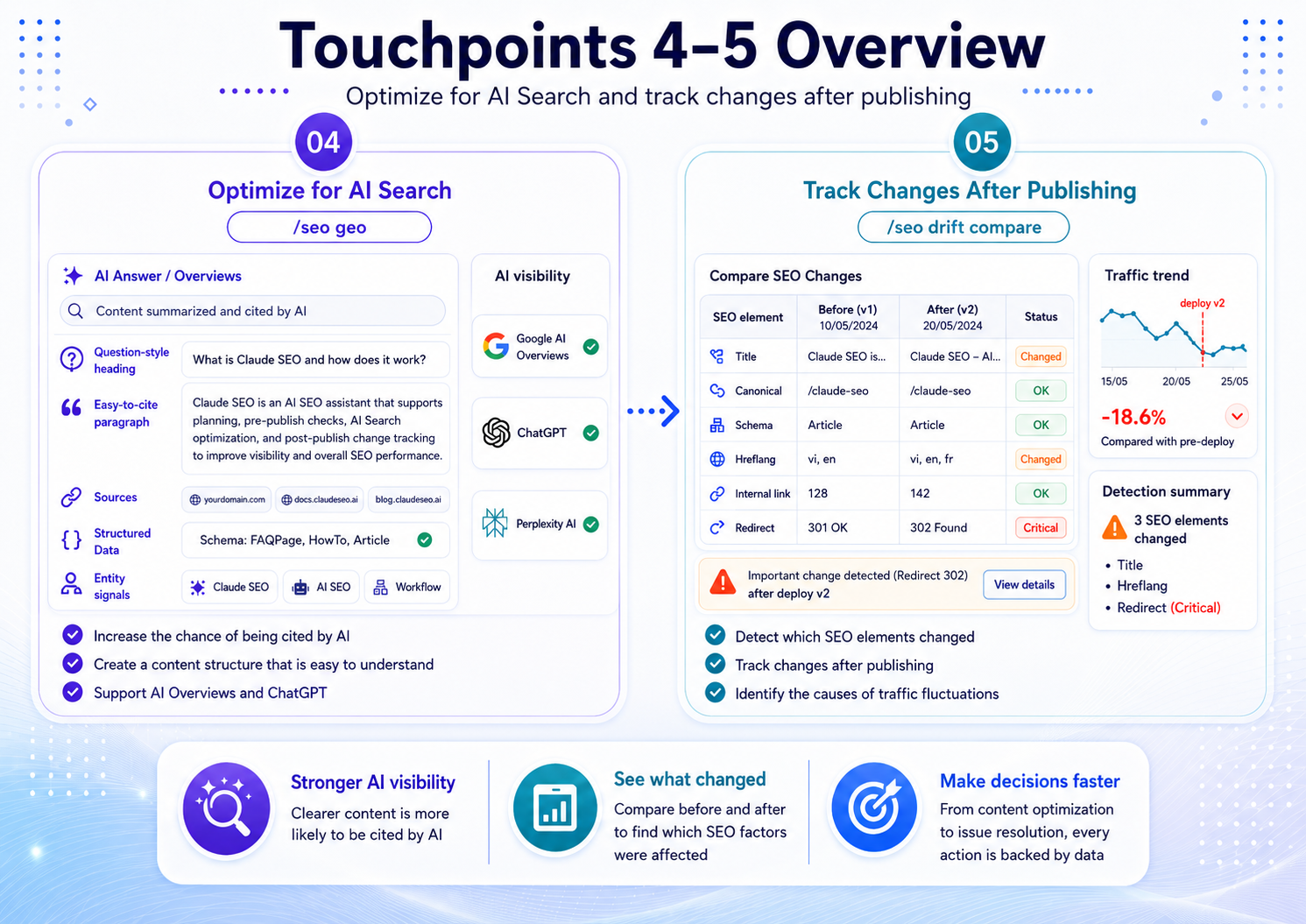
Turning “traffic dropped” into “a specific cause”.
Conclusion: Claude SEO changes how you operate, not just which tool you use
Claude SEO will not help you write more content.
It helps you:
- Produce content more systematically
- Reduce operational errors
- Connect SEO with marketing
- Understand why traffic changes
But most importantly:
It does not replace strategy.
A tool cannot decide:
- What to write
- Who to target
- Which topics to prioritize
That remains the marketer’s role.
Struggling to turn ideas into reality? With a proven track record of over 1,000 clients, our agile and flexible team will accelerate your business growth.
Book a Free ConsultationMore on "Generative AI & ML"

AI API Token Optimization: Cut Costs
A practical guide to AI API token optimization. See how conversation history, RAG documents, tool outputs and response length were reviewed to reduce input tokens from about 8,000 to 1,600 while preserving the information needed to answer users.
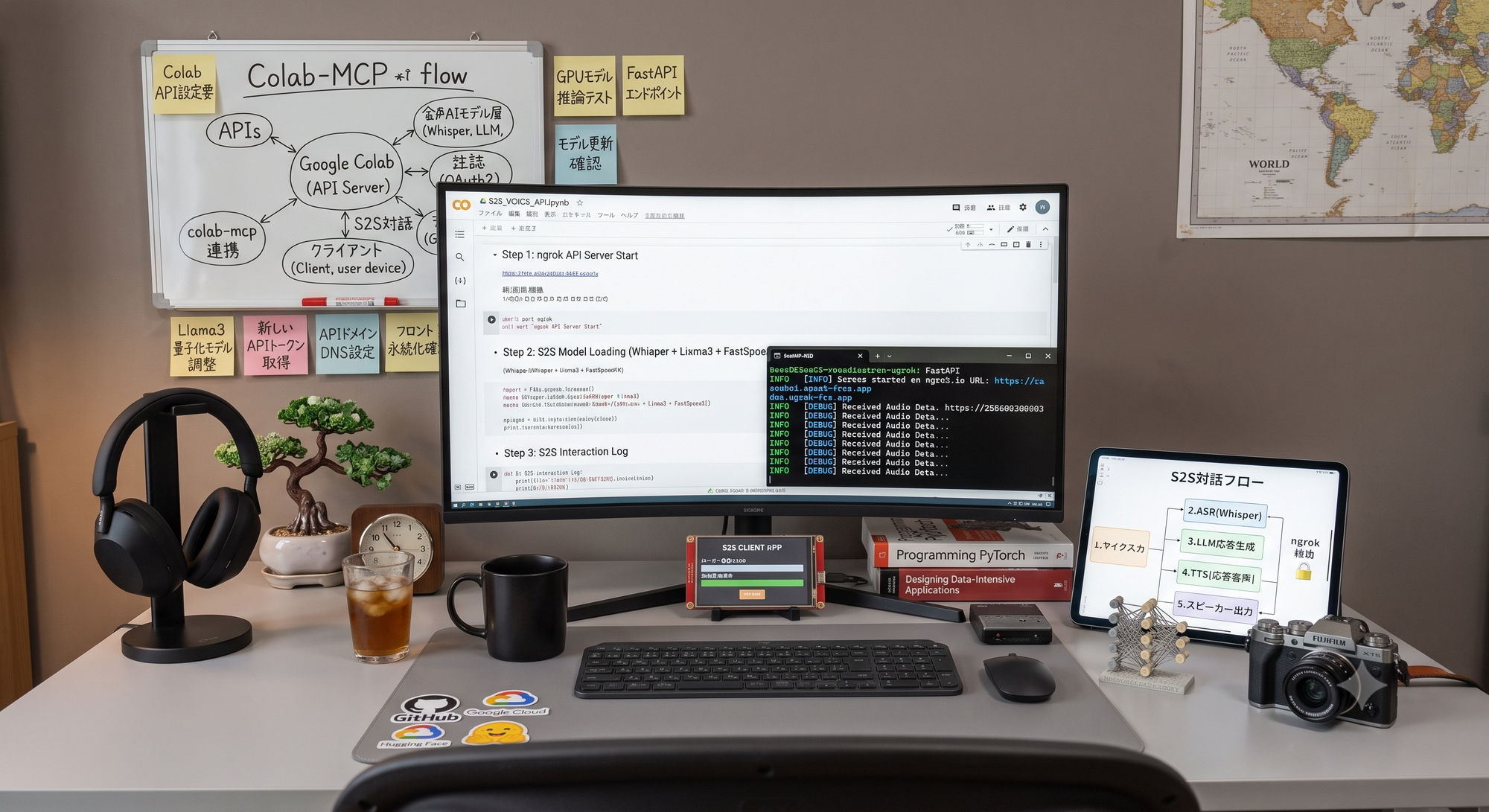
Turning Google Colab into an API Server to Run Speech-to-Speech Voice AI
This PoC turns Google Colab into a temporary WebSocket server for speech-to-speech AI. It combines faster-whisper large-v3, Gemini 2.5 Flash-Lite, VOICEVOX and Silero VAD, then improves latency through sentence buffering, streaming responses and parallel TTS generation.

AI Voice Production: 5 Best Practices
AI voice content uses two AI stages: script generation and text-to-speech. This guide explains how to test predefined voices, turn subjective feedback into requirements, manage versions, prioritize trade-offs, run group listening sessions and use post-processing to stabilize quality.
