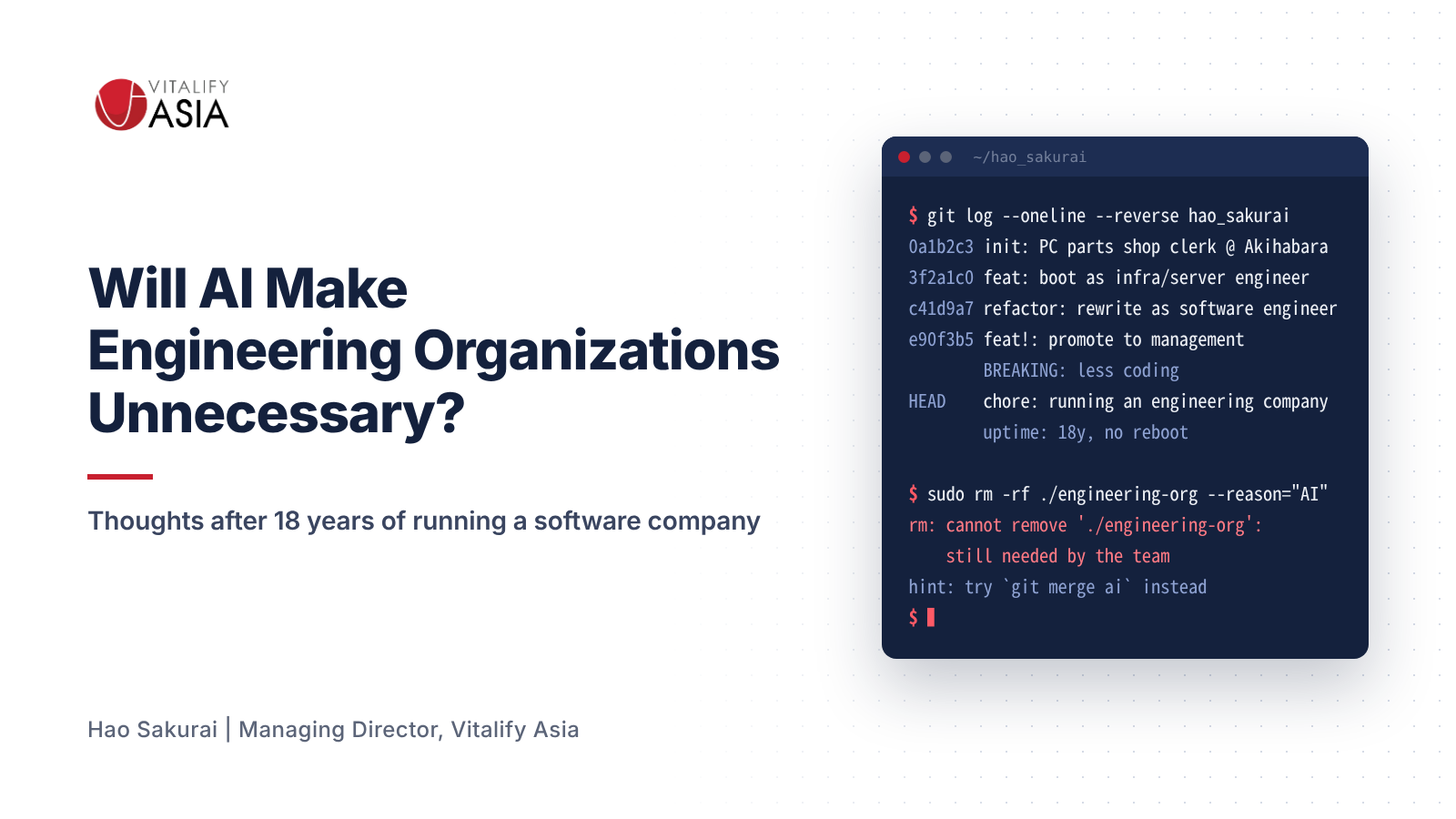
Will AI Make Engineering Organizations Unnecessary? Thoughts After 18 Years of Running a Software Company
Generative AI now lets small teams build software. So do we still need engineering organizations? Hao Sakurai, Managing Director of Vitalify Asia, draws on 18 years of running a software company to look at technology, teamwork, and developing people.
On this page
- How Is AI Changing Software Development?
- The value of "building" is changing fast
- From writing code to delivering value
- Hiring Engineers Is Not the Same as Building a Development Organization
- Is having talented engineers enough?
- Experience from keeping up with technological change
- Teamwork and knowledge sharing: a never-ending challenge
- What Kind of Engineering Organization Should We Build in the Age of AI?
- Beyond technical skills: the ability to understand business
- Precisely because it is the age of AI, I want to develop young engineers
- Because individuals can do more, teamwork matters more
- Toward an organization where small teams create greater value
- Closing: Will AI Make Engineering Organizations Unnecessary?
Generative AI is rapidly reshaping how software is built.
Programs that once required a specialist engineer can now be prototyped through a conversation with AI. For simple applications, more and more people are able to build something that works, even without deep programming expertise.
As these changes unfold, there is a question I have been hearing more and more often:
In the years ahead, will we still need engineers, development companies, or even engineering organizations at all?
I started out as an infrastructure engineer, then worked as a server engineer and a software engineer, before moving into management and eventually running a company. Eighteen years ago, I joined my current company at its founding, and I have been involved in running it ever since. Even so, I still value looking at things through an engineer's eyes.
Of all the technological shifts I have experienced, I feel the change brought by generative AI is one of the most significant. That is exactly why I want to think this through again.
Will engineering organizations become unnecessary in the age of AI?
Let me give you my answer up front. Organizations that simply build what they are told, by throwing people and hours at it, will become unnecessary because of AI. But if you are building software that many people use, that keeps improving, and that keeps making someone's work or life better, an engineering organization becomes more necessary than ever.
Being able to build software and having an engineering organization are two completely different things.
Precisely because AI lets each person do more on their own, we need organizations where no one has to carry everything alone. Let me explain why, drawing on my own experience.
How Is AI Changing Software Development?
The value of "building" is changing fast
In the past, writing software demanded a great deal of time and specialized knowledge. Generative AI is fundamentally changing that premise.
AI can now support many stages of development: not just generating code, but also discussing design, supporting testing, analyzing existing code, and writing documentation.
Of course, AI alone cannot deliver complex systems or development that demands high quality. Even so, the areas where AI can reduce implementation effort have already expanded, and I believe they will keep expanding.
This is not entirely good news for development companies. The value of delivering the same work with the same number of people and the same amount of effort is already being questioned. I feel we are right in the middle of a major transition.
Still, I don't see this purely as a negative change. The time that used to go into building software can increasingly be spent on more valuable work.
From writing code to delivering value
Even if AI can generate code in a short time, that code does not automatically become software that delivers value to its users.
What should we build? Which technologies should we choose? How do we ensure quality? How do we handle security issues? And how do we keep improving a service after it launches?
These challenges remain. In fact, as development speeds up, decision-making and quality control are becoming the new bottlenecks.
The core of what engineering is expected to deliver is shifting. I think many people involved in software development can feel this change.
Hiring Engineers Is Not the Same as Building a Development Organization
Is having talented engineers enough?
With AI, even small teams can develop software more easily. For many companies, hiring their own engineers and bringing development in-house has become a more realistic option than before.
I am in favor of in-house development itself. There is great value in having people who deeply understand their own business also hold technical skills and keep improving things over time.
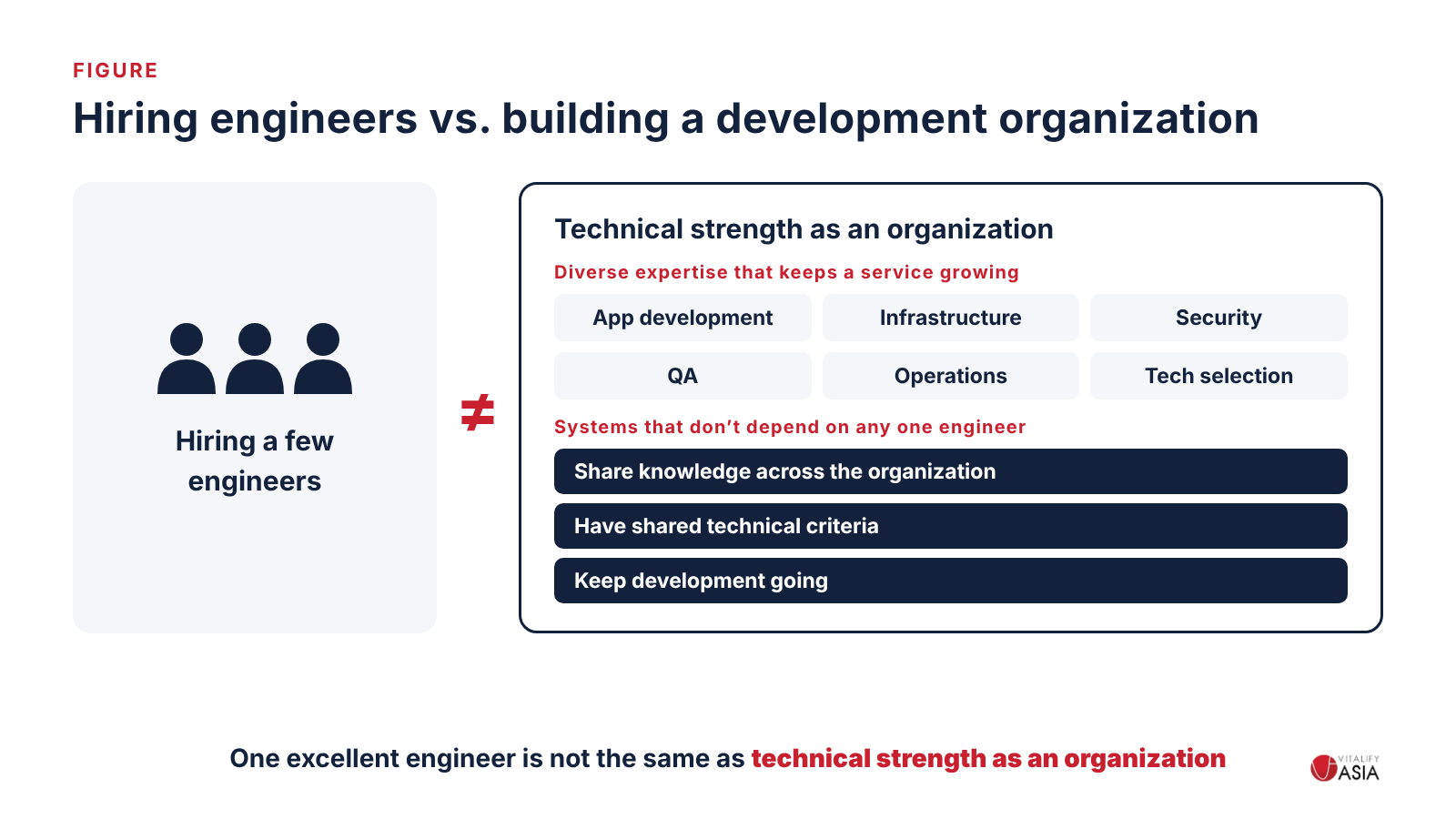
However, hiring a few engineers does not, on its own, create an engineering organization.
To keep a service growing over time, you need a wide range of expertise beyond application development: infrastructure, security, quality assurance, operations and maintenance, technology selection, and more.
You also need systems that let the organization share knowledge, hold shared criteria for technical decisions, and keep development going without depending on any one engineer.
Having one excellent engineer is not the same as having technical strength as an organization.
Experience from keeping up with technological change
What I have come to feel strongly through many years of running a development company is that technical capability is not something you acquire once and keep forever.
At our company, Vitalify Asia (VFA), we have worked on machine learning since our earliest days. I myself had been involved in image recognition even before that, back when tools like OpenCV's Haar training were the norm.
We have built many services using face recognition and logo recognition. One of them was Pashapon!, launched in 2008, which detected and extracted faces from photos taken on mobile phones and turned them into emoji for "deco-mail," the decorated emails that were popular in Japan at the time. Back then, I even built the face recognition models myself. We would prepare tens of thousands of tiny 12×12-pixel face images and train on them for days with inexpensive GPUs, over and over again.

I was also involved in developing technology for note and document scanning, such as KING JIM's SHOT NOTE and SHOT DOCS, as well as several business card scanning apps.

Later, when deep learning was drawing enormous attention, the VFA AI team that I led directly at the time took on Kaggle, the machine learning competition platform run by Google, and one of our members earned the title of Kaggle Master, one of its top ranks.
In addition, an AI-based technology for predicting customer response to real estate listings, developed at VFA, was granted a patent in 2020 (Japanese Patent No. 6670406).
Today, we continue to take on new areas of technology such as generative AI, WebGPU/Web3D, and digital twins.
Looking back, I have witnessed major technological shifts many times. That experience is why I see today's generative AI as the result of many years of accumulated research and technological progress.
That said, I am honestly amazed by how fast things are moving now. Having focused on management for so long, I have to admit that I am barely keeping up.
That is exactly why I want to keep catching up on how people across our organization are using new technologies, and keep thinking about what those technologies make possible and what value they can bring to our clients.
Teamwork and knowledge sharing: a never-ending challenge
One of the things we have valued most in our engineering organization over the years is teamwork.
Simply bringing together highly skilled individuals does not guarantee that an organization will perform at its full potential. What matters is sharing the knowledge and experience each person gains with others, and raising the capability of the whole team.
At VFA, we have also placed importance on sharing not only technical knowledge but also an understanding of our clients' industries and operations across the team.
That said, sharing information is not easy. Each project brings different knowledge, and technology keeps changing. What one person understands cannot always be conveyed accurately to others.
Information sharing has been a long-standing challenge for us, and we are still working to improve it. It is not a problem you can solve by introducing a single system; it takes ongoing effort.
AI can help organize documents, search for knowledge, and make information sharing more efficient. But it will not automatically create a culture of sharing knowledge, or a mindset of working together to solve problems.
Developing not just people who use technology, but teams that can make the most of it: that, too, is an important role of an engineering organization.
What Kind of Engineering Organization Should We Build in the Age of AI?
Beyond technical skills: the ability to understand business
One ability I believe will become increasingly important for engineers is understanding their clients' business.
Every industry has its own specialized knowledge and ways of working. Engineers do not need to understand all of it as deeply as domain experts do.
But they do need to talk with experts, grasp the essence of the work and its challenges, and propose solutions from a technical perspective; to compare options, make technical judgments, and build consensus through discussion with stakeholders. I believe these abilities will matter more and more.
As AI speeds up implementation, we are now able to spend more time than ever on understanding problems and exploring solutions.
People who don't just know technology, but can think about what should be achieved with it. I want to grow more engineers like that.
Precisely because it is the age of AI, I want to develop young engineers
These abilities may seem to favor experienced engineers. But they are not determined by years of experience alone.
They also vary greatly depending on which industries and clients someone has worked with, what roles they have taken on, and their own personal qualities.
I also see great potential in developing the younger generation now entering the IT industry.
For people who start learning and building with AI as a given, it may be possible to explore a wide range of technologies and experiment in less time than before.
On the other hand, if they simply adopt whatever answer AI generates, they may miss out on the experience of thinking through why a particular approach is chosen, or where its problems lie.
That is why, alongside the ability to use AI, the experience of talking with real clients and experts, understanding problems, making their own decisions, and reflecting on the results will be important.
Industry knowledge, communication skills, the ability to make proposals, judgment, and consensus-building. Rather than letting this knowledge and experience stay with individuals, we want to share it as an organization and pass it on to the next generation.
I want to further strengthen that kind of system for developing people.
Because individuals can do more, teamwork matters more
Ideally, if we had "super generalists" who can do anything better than most, "super specialists" who are second to none in their fields, and "super rookies" who absorb things quickly and adapt with ease even without experience, combining them with AI might let us handle a great many challenges.
But such people are rare, and only a limited number of companies can hire them. It is not realistic to build an organization on the assumption that such ideal talent will be available.
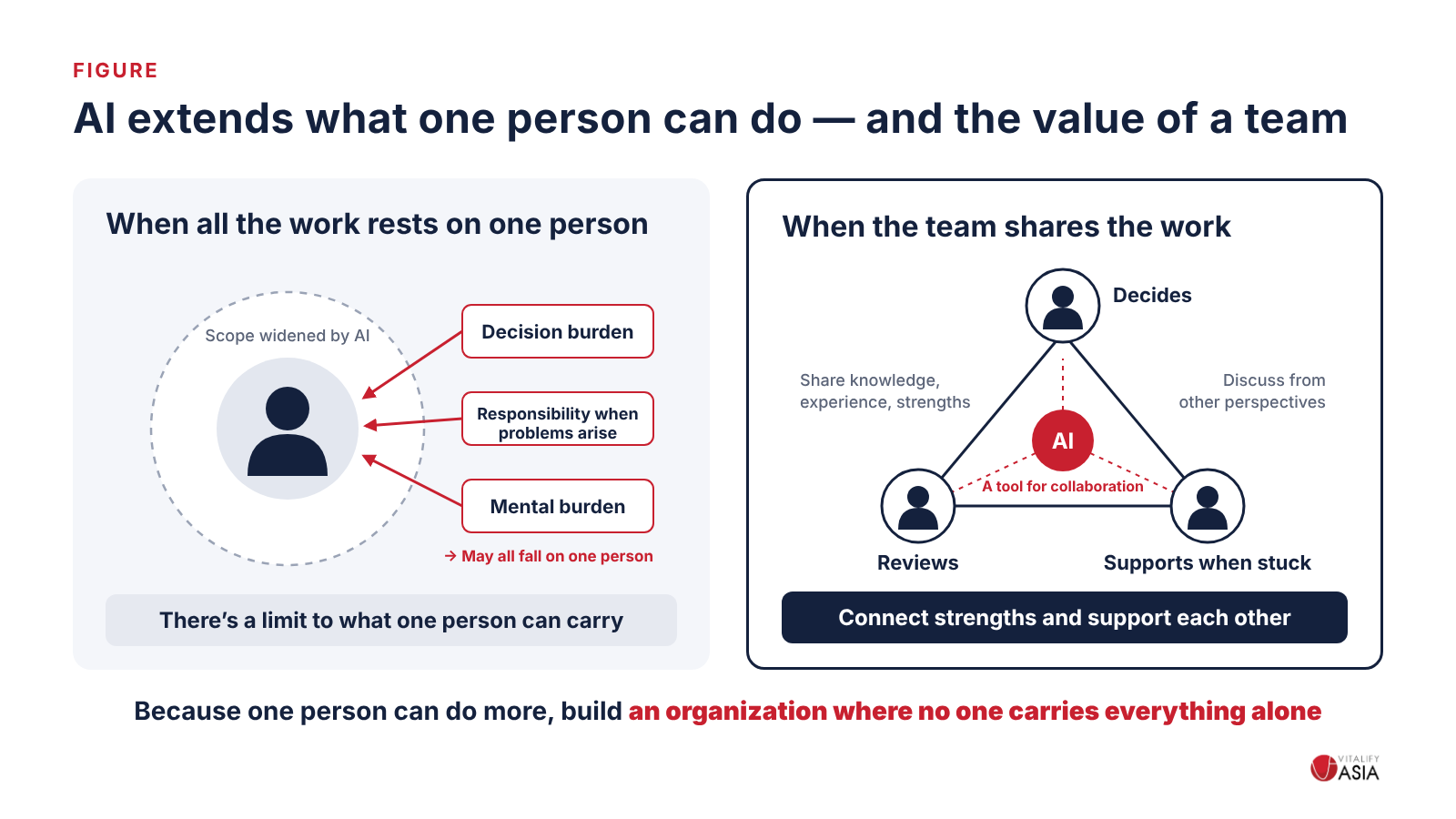
And no matter how capable someone is, there is a limit to the decisions and responsibilities one person can carry alone.
Even if AI expands the range of work a person can handle, the judgments and checks that are needed don't necessarily shrink in the same way. If work is concentrated on one person, not only the burden of decision-making, but also the responsibility and mental strain when something goes wrong, may all fall on that one person.
That is why I believe teamwork is becoming even more important.
Sharing each person's knowledge, experience, and strengths. Discussing decisions that are hard to make alone with members who bring different perspectives. Dividing roles and responsibilities, checking each other's work, and supporting one another.
Dividing responsibility here does not mean blurring who is accountable. It means making clear who decides, who checks, and who steps in to help when someone is struggling.
AI can also be a tool that supports this kind of collaboration. It can serve as an entry point to understanding knowledge outside your own field, help organize materials, and help clarify the key points of a discussion and where people's understanding differs.
Of course, AI's explanations are not always correct, and checking with experts and talking with teammates remain necessary. Even so, I feel it can help people with different specialties understand each other's work and work together.
Not everyone needs to be able to do everything. If each person develops their strengths and combines them with the strengths of others, we can solve problems as a team.
Precisely because AI lets each person do more on their own, I want to build an organization where no one has to carry everything alone.
That is one way I envision an engineering organization in the age of AI.
Toward an organization where small teams create greater value
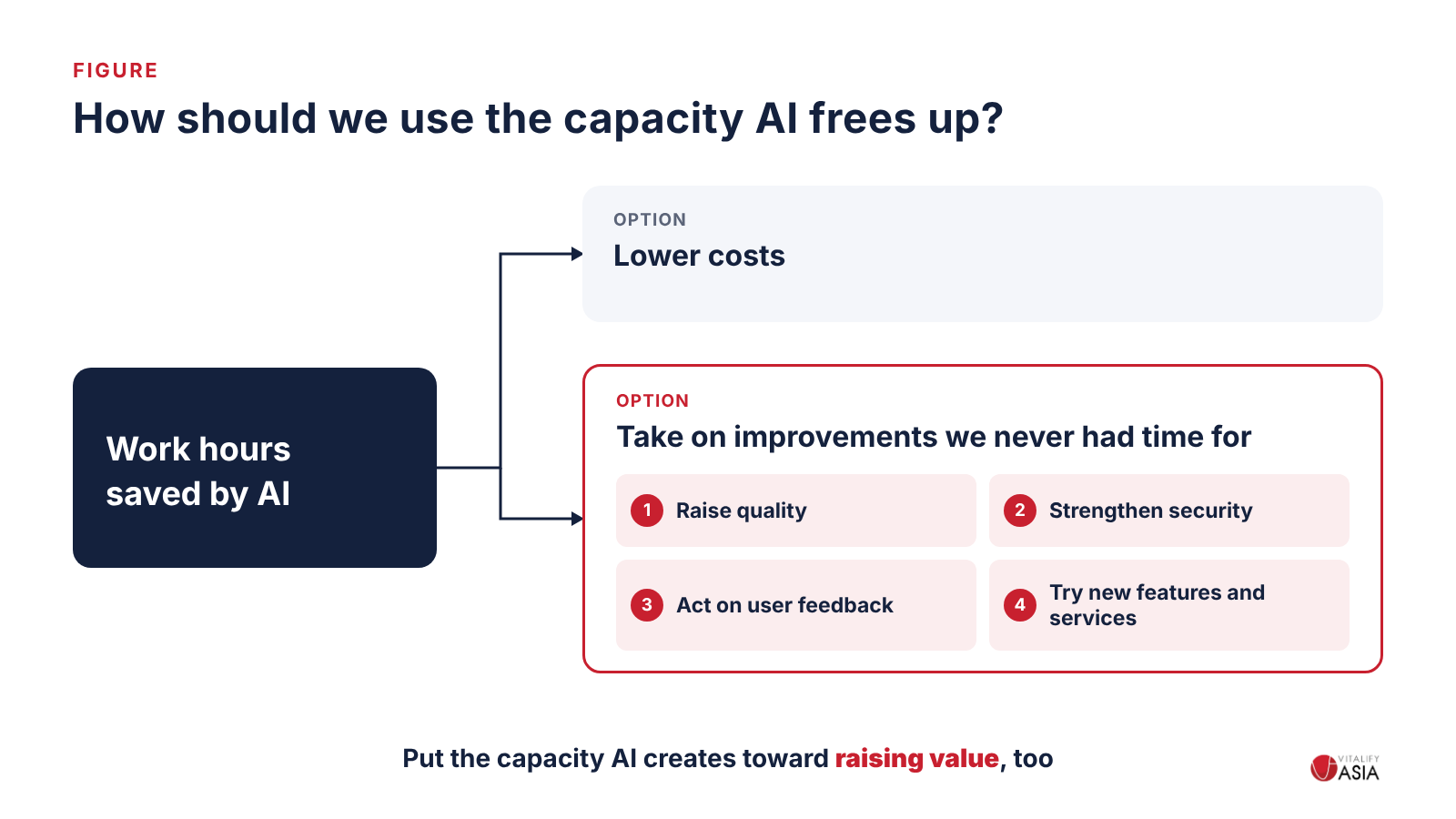
With AI, work that once required many people dividing up roles and spending a lot of time can now be done by fewer people in less time.
So how should we use the effort we save?
One option is to lower costs. On the other hand, we can also take on improvements we never had time for before.
Raising quality. Strengthening security. Reflecting users' voices. Trying new features and services.
I want to use the capacity that AI creates to raise this kind of value as well.
For engineers who love technology, are interested in their clients' business, and can think and propose things on their own, this may well become an increasingly exciting time.
Of course, not every engineer needs to play the same role. Some will pursue advanced technical expertise; others will excel at working with clients or making technical decisions.
For young engineers, too, I don't expect everything from the start. I hope they will find their strengths with the support of their team and gradually expand the range of decisions they can make.
Creating value as a team while making the most of each person's expertise and strengths. I want to develop engineers like that, and build an organization where they can thrive.
Closing: Will AI Make Engineering Organizations Unnecessary?
No one can accurately predict how far AI will evolve, or how much it will change the work of engineers.
But as I said at the beginning, organizations that simply build what they are told, by throwing people and hours at it, will likely become unnecessary. Even so, I don't believe engineering organizations themselves will become unnecessary.
Of course, not every development project needs a large organization. Some work can be handled perfectly well by an individual or a small team. The right structure depends on the nature of the business and the system.
Even so, the judgment and responsibility needed to decide what to build, deliver it safely, and keep improving it will remain. There is great value in not relying on a single person for those capabilities, and instead sharing knowledge and continuing to grow them while supporting one another.
After 18 years of running a development company, what I feel is that there is no finished form when it comes to building an engineering organization. When technology changes, the people we need, the way we work, and the shape of the organization all change too.
Precisely because AI keeps evolving, I want us to be an organization that enjoys technological change, develops people, connects each person's strengths, and keeps solving our clients' problems. And together with our clients, I want to maximize the value that reaches the people who use the software we build.
That is one of the reasons I will keep running an engineering organization.
Struggling to turn ideas into reality? With a proven track record of over 1,000 clients, our agile and flexible team will accelerate your business growth.