Securing and Scaling Your Apps with AWS CloudFront
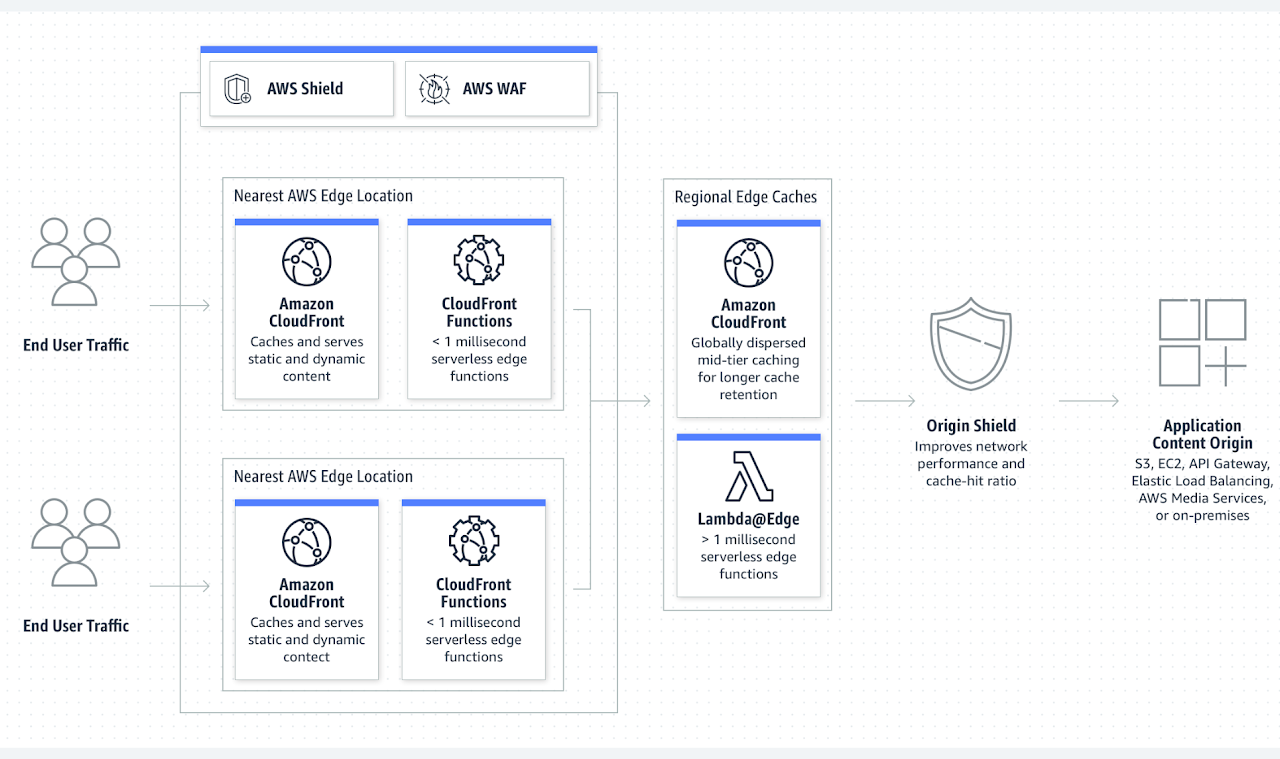
AWS CloudFront is a CDN with built-in security controls such as SSL/TLS encryption, DDoS protection, and WAF.

On this page
Why AWS CloudFront is More Than Just a CDN?
When most developers hear 'AWS CloudFront,' they immediately think of faster image loading and caching static assets. But treating CloudFront as just a CDN is leaving a massive amount of value on the table.
Once your app goes live, delivering content quickly is only half the battle; keeping malicious traffic out and keeping your cloud bill under control is the real challenge. Instead of configuring complex security perimeters at your origin server, here is why CloudFront should actually be your application's first line of defense.
SSL/TLS Encryption (Without the Headache)
Encrypting traffic between your users and your app is a baseline requirement today to prevent eavesdropping and man-in-the-middle attacks. CloudFront makes this straightforward by giving you two main routing options:
- SSL/TLS Termination: CloudFront decrypts the traffic at the edge location, inspects/caches it, and then re-encrypts it before sending it to your origin server.
- SSL/TLS Pass-through: CloudFront just passes the encrypted payload directly to your server without decrypting it at the edge.
Pro-tip: CloudFront integrates seamlessly with AWS Certificate Manager (ACM) to provision free SSL/TLS certificates. No more buying certs or manually handling renewals.
Out-of-the-Box DDoS Protection
Nobody wants to wake up to a downed server because of a SYN, UDP, or HTTP flood. Out of the box, CloudFront automatically detects and mitigates common DDoS attacks. If you are running enterprise workloads and need heavy-duty protection against advanced attacks, you can easily integrate it with AWS Shield Advanced.
Granular Access Control
Sometimes you need strict control over who can access your content. CloudFront handles this natively:
- Geo-restriction & IP blocking: You can easily block or allow traffic from specific IP addresses or entire countries.
- AWS IAM Integration: For private assets or internal services, you can tie CloudFront to AWS Identity and Access Management (IAM) to restrict access based on specific roles and permissions.
Edge Defense with AWS WAF
By pairing CloudFront with AWS Web Application Firewall (WAF), you push your security perimeter to the edge. You can write rules to inspect incoming requests and block malicious traffic—like SQL injections or cross-site scripting (XSS) attacks—before they ever reach your origin server. It’s a foundational piece for building a layered security architecture.
Keeping Data Transfer Costs Down
Beyond security, CloudFront is a lifesaver for your AWS bill. By caching your content at edge locations globally, you drastically reduce the expensive long-distance data transfer from your origin server. Just tweak your Cache-Control headers and let the edge do the heavy lifting.
If you're just getting started or running smaller apps, the AWS Free Tier for CloudFront is incredibly generous. You get 1 TB of outbound data transfer and 10 million HTTP/HTTPS requests every single month at zero cost.
Wrapping Up
AWS CloudFront is a lot more than just a CDN for serving images faster. With built-in SSL/TLS management, automated DDoS mitigation, WAF integration, and serious cost-saving caching, it is an easy win for building secure, scalable architectures. If you aren't routing your web traffic through it yet, it’s definitely worth testing out.
References:
Struggling to turn ideas into reality? With a proven track record of over 1,000 clients, our agile and flexible team will accelerate your business growth.