
SEO in the Age of AI Search: Build a Knowledge System, Not Just More Articles
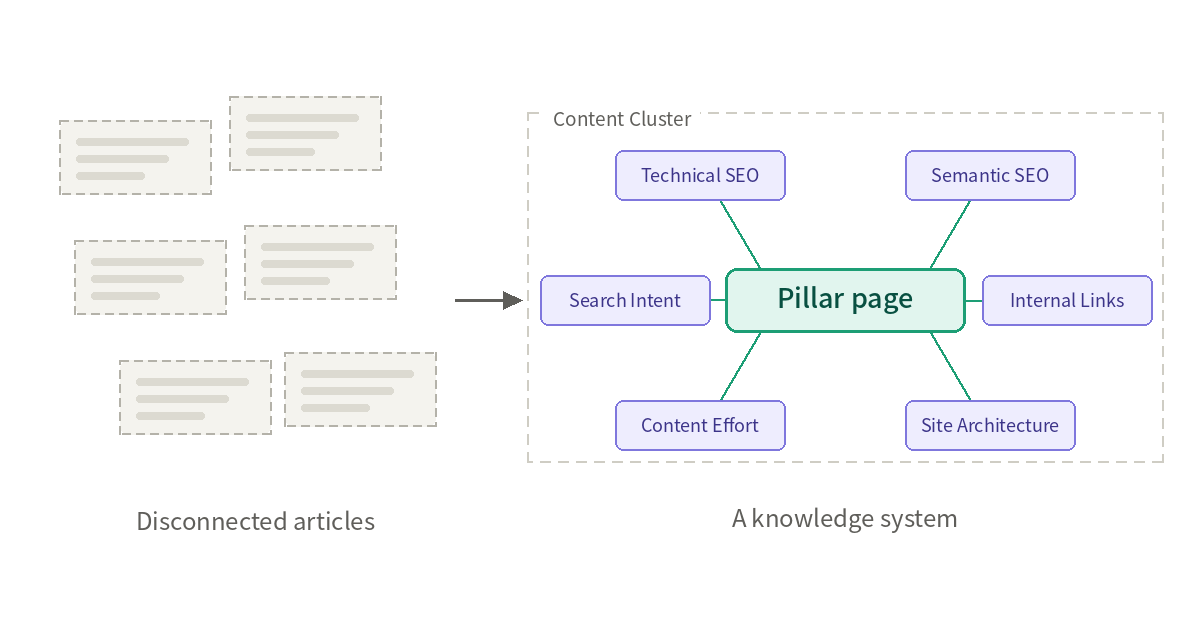
For years, SEO has been carried out according to a fairly familiar formula: research keywords, write the article, optimise the title, build backlinks, then wait for rankings to climb.
That approach still works to a degree. However, the rise of AI Search, successive core updates, and the details that surfaced through the 2024 Google API leak all point to the same thing: Google is trying to evaluate websites at a far deeper level than before.
Key takeaways
- Google doesn’t just read individual pages — it is trying to form an overall picture of the entire site.
- Topical Authority doesn’t come from the number of articles, but from topic coverage and how content is organised.
- Semantic SEO is about organising meaning and the relationships between pieces of content, not stuffing in synonyms.
- Content Effort reflects genuine investment: original data, first-hand experience, concrete examples.
- AI should be a research assistant, not a mass production line for articles.
How is Google evaluating websites in the age of AI Search?
What did the Google API leak suggest?
In 2024, the SEO community paid close attention to the Google API leak, when a large volume of internal documentation and data fields relating to the search system became public. Google has not confirmed that every field is used directly in ranking, so this should not be treated as a secret recipe for reaching page one.
What deserves more attention is that a number of concepts the SEO community had previously discussed only as hypotheses turned out to have names, including:
- Topic Authority
- Topicality Score
- Site Focus Score
- Page Embedding
- Site Embedding
- Content Effort
The presence of these terms suggests Google is building systems capable of understanding a website semantically: what the site is about, how tightly focused it is, how its pages relate to one another, and whether the content shows evidence of real investment.
In other words, Google isn’t only reading individual pages. The search engine is also trying to form a picture of the site as a whole.
That said, a caveat is in order. The appearance of a term in leaked documentation does not mean Google has published an official definition or a specific scoring formula. We know the names of the data fields, but not which ones are used directly in ranking, or with what weighting. The sensible reading is to treat the documents as a hint about how Google thinks, not as a formula to apply literally. Within SEO, Topical Authority is simply how practitioners describe a site’s ability to build credibility and depth in a given field.
What is Topical Authority?
Topical Authority can be understood as the degree of expertise and credibility a website holds for a specific topic.
Suppose two websites both publish content about SEO.
The first site has only a handful of basic articles:
- What is a backlink?
- What is on-page SEO?
- How to write a meta description
The second site has built a content system covering many facets:
- Technical SEO
- Entity SEO
- Internal linking
- Crawl budget
- JavaScript SEO
- Indexing
- Google Discover
- AI Search
- Search Quality Evaluator Guidelines
The content on the second site isn’t just more plentiful — it’s grouped into clusters, interlinked, and directed at a single overarching topic. Even without knowing which brand sits behind either site, a reader will quickly recognise that the second one has greater depth. Google is attempting to assess websites in much the same way.
It’s also worth distinguishing Topical Authority from Domain Authority. Domain Authority is a metric calculated by third-party SEO tools, based largely on backlinks, and is not a Google metric. Topical Authority is tied to content coverage and how information is organised within a field, rather than reducing to a single number.
Topical Authority is not, however, created by article count alone. A site with hundreds of articles can still lack expertise if the content is fragmented, duplicated, or fails to fully address what users need.
To build credibility around a topic, a site needs to organise content according to context and the relationships between concepts. That is precisely the role of Semantic SEO.
Semantic SEO is not keyword stuffing
Semantic SEO is often understood as finding additional synonyms, related keywords, or industry terms and inserting them into an article. That understanding is incomplete.
Semantic SEO is the process of structuring content so search engines can understand the topic, context, and relationships between the information on a site.
Take a site about water purifiers. A single article explaining what a water purifier does isn’t enough to demonstrate real depth. A fuller content system might cover:
- RO water purifiers
- Nano-filter water purifiers
- What TDS levels mean
- How filter cartridges work
- How often cartridges should be replaced
- How to choose a unit for a household
- Maintenance costs
- Drinking water standards
- Brand comparisons
- Common problems during use
Each article answers a distinct question, but all of them belong to a larger body of knowledge. When these pieces are sensibly interlinked, Google not only understands what each page is about but can also recognise the relationships between pages and the topic the whole site is focused on.
Good semantic structure alone still isn’t enough, though. A site also needs to demonstrate that its content is seriously developed and genuinely solves the reader’s problem. This is where the concept of Content Effort becomes relevant.
Google may be able to assess how much effort went into content
Content Effort can be understood as the level of investment evident in how a piece of content was built. This does not mean longer is better.
An article of several thousand words can still hold little value if it merely restates information already available elsewhere. A shorter piece with original data, hands-on experience, and clear guidance can be considerably more useful.
Google may observe a range of signals related to content quality:
- Completeness of information
- Originality
- First-hand experience
- Data or cited sources
- Supporting visuals
- Concrete examples
- Whether it actually solves the reader’s problem
A practical example. Consider two articles explaining how to register a Google Business Profile.
The first simply paraphrases Google’s existing help documentation, with almost no examples or first-hand experience.
The second describes the business verification process as it actually plays out, the errors people commonly hit during video verification, how to handle a suspended listing, and includes screenshots taken during real implementation.
The second demonstrates clear investment because it doesn’t just aggregate information — it adds experience and specific solutions.
This leads to an important principle: rather than aiming to produce as many articles as possible, focus on completing the entire body of knowledge surrounding a topic.
Don’t chase article count — complete the topic
A common mistake in SEO is setting content targets by volume: this month we need another 50, or 100, articles.
That may work as a production quota, but it isn’t necessarily a good SEO objective. The more useful question is:
What does a reader need to know in order to fully understand this topic and make a decision?
Take a travel site about Da Nang. Three articles — “What to do in Da Nang”, “What to eat in Da Nang”, “Da Nang hotels” — cover only a small fraction of what readers actually need.
A more complete content system might include:
- The best time of year to visit
- Getting around
- Itineraries by trip length
- Attractions
- Beaches
- Photo spots
- Trip costs
- Hotels by district
- Local food and specialities
- Advice for families with young children
- Advice for couples or older travellers
- Tours and local services
When these pieces are organised and interlinked, the site stops being a loose collection of articles. It becomes a resource capable of supporting users across the whole journey of researching and planning a trip.
This also means there is no fixed answer to “how many articles do we need”. Ten articles that fully resolve a topic can outperform a hundred fragmented ones. A more practical measure is whether readers have to leave the site to find their next answer.
In a landscape where AI can generate content extremely quickly, this distinction matters more than ever.
AI can write thousands of articles, but volume doesn’t create expertise
AI has made content production dramatically faster. With a handful of prompts, a business can generate hundreds of ideas, outlines, or drafts in a short space of time.
That can help a site scale quickly, but it also introduces a significant risk: publishing content at volume without strategy, experience, or new value.
Early on, such sites may still attract traffic if the content answers some search queries. But when Google reassesses the site as a whole, problems tend to surface:
- Duplicate content
- Multiple articles serving the same search intent
- Superficial information
- No data or first-hand experience
- Fragmented content structure
- Expansion into too many unrelated topics
The problem isn’t that the content was produced with AI. Google assesses the quality and usefulness of content, not the tool that created it. The problem is that AI gets used to increase volume without improving the quality or structure of the content system — and that risk exists equally for content mass-produced by humans.
So rather than treating AI as a replacement for writers, it’s more useful to treat it as an assistant supporting research and strategy.
AI should be the SEO practitioner’s assistant
AI delivers the most value in the stages that require analysis, synthesis, and expansion of information. It can help with:
- Topic analysis
- Identifying important entities
- Expanding on user questions
- Suggesting content clusters
- Detecting content gaps
- Proposing article structures
- Checking semantic relationships
- Analysing internal links
- Auditing pages at risk of overlapping search intent
People then need to review and finish the work, drawing on:
- Search data
- Business objectives
- Practical experience
- Subject-matter expertise
- Customer insight
- Internal data
- What the business can realistically deliver
A reasonable workflow might look like this:
- People define the topic and business objectives
- AI helps expand and group the content
- The SEO practitioner verifies search intent
- Subject-matter experts add experience, data, and real examples
- The content is connected into a system
- The site keeps updating based on performance and emerging needs
AI accelerates the work of building a knowledge system. But final decisions about structure, accuracy, and value should stay with people.
Without oversight of the grouping stage, AI will readily propose multiple topics that mean nearly the same thing. That leads to content cannibalisation.
Content cannibalisation still happens
Content cannibalisation occurs when several pages on the same site compete for one search intent, or try to solve near-identical needs.
For example, a site selling air conditioners might have:
- Panasonic air conditioners
- Panasonic air conditioner prices
- Cheap Panasonic air conditioners
- Are Panasonic air conditioners any good?
- Should you buy a Panasonic air conditioner?
Having multiple articles that mention the same brand doesn’t automatically cause cannibalisation. The problem appears when the content, structure, audience, and search intent are so close that Google struggles to determine which page to prioritise.
The clearest signal sits in Google Search Console: a single query surfacing multiple URLs, with rankings rotating between them. When you see that, compare the search intent of each page before deciding what to do.
Deleting articles isn’t always the answer. First, clarify what role each page plays:
- Category pages serve the need to browse and buy
- Review articles serve the need to assess quality
- Comparison articles serve the need to choose
- Pricing articles serve the need to check budget
- How-to articles serve the need to use and maintain the product
If two pages genuinely serve the same search intent, the options worth considering are:
- Merging the content
- Redirecting a URL
- Adjusting what each article targets
- Restructuring internal links
- Designating one primary page and treating the others as support
Cannibalisation is therefore not simply a keyword problem. It’s a sign that roles within the content architecture haven’t been clearly assigned. This is also why site architecture is increasingly a competitive advantage.
Site architecture is becoming a competitive advantage
A modern website shouldn’t be built as a warehouse for articles. It should be organised like a library:
- Main topics are areas of knowledge
- Pillar pages are the overview guides
- Content clusters are the groups of in-depth material
- Individual articles answer specific questions
- Internal links are the paths connecting the information
- Product or service pages are where users can take action
When the structure is clear, Google can more easily understand:
- Which topics the site focuses on
- Which pages provide the overview
- Which pages play a supporting role
- How the topics relate to one another
- Which page suits each search need
Users, too, can move more easily from researching to comparing to deciding.
A site with strong content but a fragmented structure can leave both Google and readers unable to see its depth. A well-organised site, by contrast, lets each article support the whole system rather than working in isolation.
Semantic SEO, Content Effort, Topical Authority, cannibalisation control, and site architecture are therefore not independent tactics. They are parts of the same system:
When these elements work together, a site doesn’t just hold more content — it becomes clearer, deeper, and more useful to both users and search engines.
Conclusion: sustainable SEO starts with a knowledge system
In the age of AI Search, the advantage doesn’t necessarily belong to the site that publishes the most articles. It may well belong to the site that covers its topic thoroughly, organises information clearly, demonstrates credible expertise, and carries readers from their first question through to a final decision.
- Topical Authority builds credibility around a topic
- Semantic SEO helps Google understand context and the relationships between content
- Content Effort demonstrates investment and real value
- Site architecture connects the whole site into a system
If you’re planning content for the coming quarter, try replacing the question “how many articles this month?” with “which topic do we want to become the most complete resource on?”
Reference : https://www.youtube.com/watch?v=QL_fgTOS4pI
Struggling to turn ideas into reality? With a proven track record of over 1,000 clients, our agile and flexible team will accelerate your business growth.
Book a Free ConsultationMore on "Business & Culture"

What I Did to Pass the PMP Exam
Nihei, a project manager at Vitalify Asia, explains how he prepared for and passed the PMP exam. From the 35-hour course and a Japanese exam guide to repeated Study Hall practice and taking the test in Bangkok, this article covers the full journey and lessons learned.

SPORTEC Thailand 2026: ASEAN Sport Tech Report
A field report from SPORTEC Thailand 2026 in Bangkok. We explore how ASEAN’s aging market is shifting Sport Tech from equipment to software and data, and how Taiwanese companies and Japan’s wellness expertise are shaping new business opportunities.

Will AI Reduce Employment in Vietnam?
Will AI reduce jobs in Vietnam? VFA's COO discusses the real impact of generative AI on offshore development and the "self-destructive curiosity" needed for the next era.
